
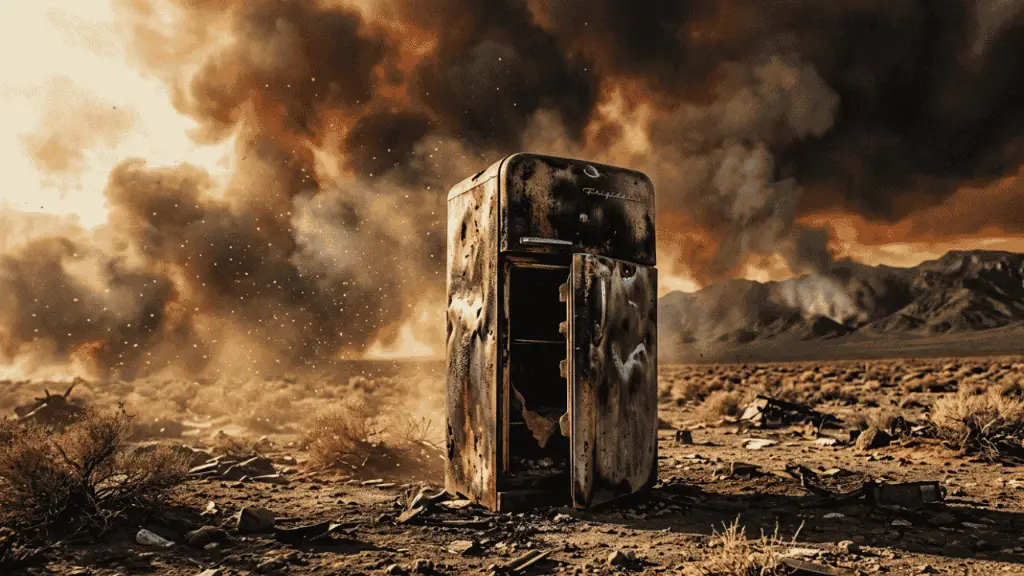
The Man Who Survived a Nuclear Blast in a Refrigerator
During the 1957 Operation Plumbbob nuclear tests, Private John R. Lively survived a 37-kiloton blast by sheltering inside a heavy-gauge steel refrigerator. Although the shockwave propelled the unit hundreds of yards, Lively emerged with only minor injuries. The Army subsequently documented the event as a unique case of survival.
The incident influenced military reports on fallout protection and later inspired the refrigerator survival scene in the Indiana Jones film franchise. Today, the dented appliance is displayed at the National Atomic Testing Museum. Lively’s experience remains a notable example of unconventional survival during the era of atmospheric nuclear testing.
Most people have never heard of John R. Lively. However, if you were alive in 1957 and reading Life Magazine, his face — dusty, grinning, and inexplicably holding a bologna sandwich — stared back at you from the newsstands.
John didn’t survive a nuclear blast because of advanced military gear or cutting-edge science. He survived because he made a split-second decision to climb inside a refrigerator. One mile from a 37-kiloton nuclear detonation.
And somehow, it worked.
This is the story of the Atomic Fridge Guy — the real-life moment that later inspired Indiana Jones and the Kingdom of the Crystal Skull, and the true nuclear survival story the U.S. Army quietly documented as a recommendation for Frigidaire.
Nevada, 1957: America Was Blowing Things Up on Purpose
Operation Plumbbob and the Quest to “Test” Nuclear Weapons
On July 26, 1957, the Nevada Test Site buzzed with activity. The U.S. government was deep into Operation Plumbbob, one of the largest nuclear testing series in American history. That morning’s test was codenamed “Priscilla” — a 37-kiloton bomb suspended from a balloon at 700 feet.
The stated mission sounded almost academic: observe what nuclear blasts do to houses, vehicles, and mannequins. Meanwhile, the Army had its own experiment running alongside it — 1,100 pigs dressed in military gear, placed at varying distances to measure blast injuries on living tissue.
It was, in short, a very strange Tuesday.
Meet Private John R. Lively, Age 22
John Lively was no scientist. He was a 22-year-old Army private assigned to what the military called “ground zero cleanup.” His job after the detonation was to enter the blast zone, collect data, and help assess damage.
His assigned position for the actual detonation? A trench, one mile from the bomb. Standard protocol called for soldiers to lie face down and pull a tarp over themselves while the bomb went off.
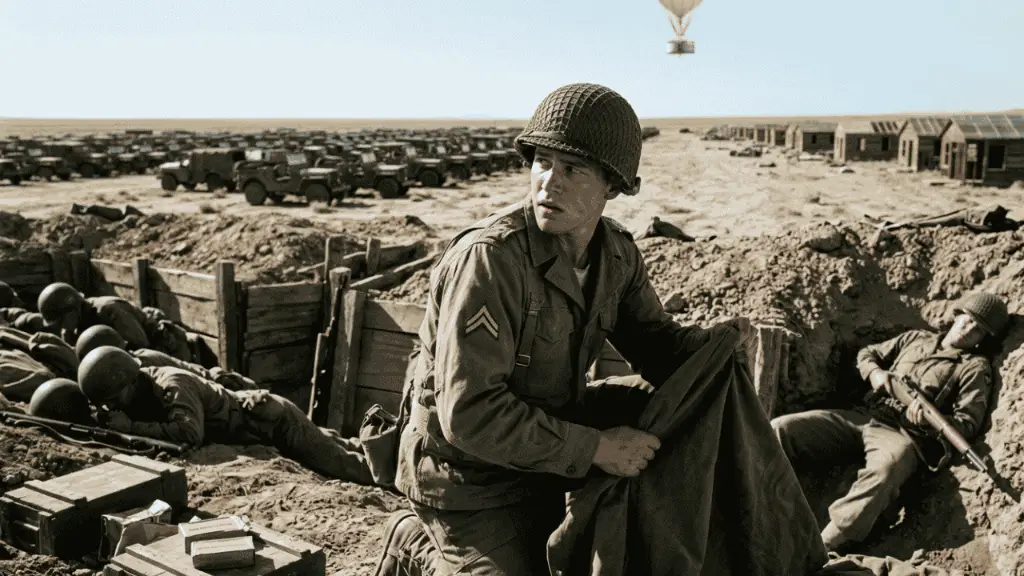
John thought the tarp was a terrible idea.
The Refrigerator Decision That Changed Everything
“Thicker Than a Tarp”
Just before the countdown began, John spotted something near the supply area — an industrial refrigerator used to store food for the troops. It was big, heavy-gauge steel, well-sealed, and built like a tank.
John did the math in his head: thick metal walls, rubber door seals, insulated interior. In his words, he simply figured it was “thicker than a tarp.“
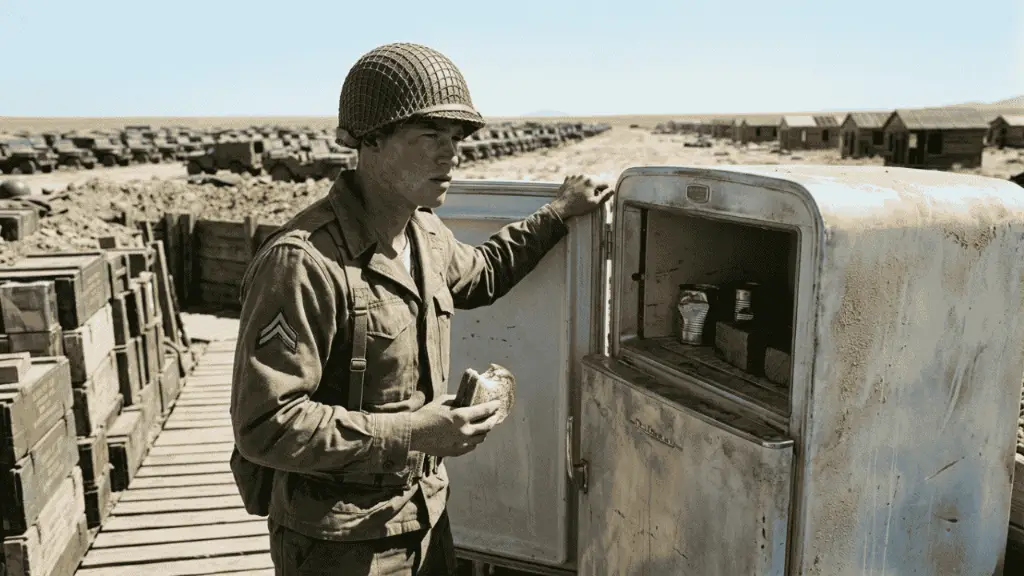
He climbed inside, pulled the door shut, and still held his bologna sandwich.
The Flash
The bomb detonated. The desert erupted in a flash that witnesses compared to ten thousand suns igniting at once. A pressure wave expanded outward at hundreds of miles per hour, obliterating everything in its path.
Inside the fridge, John heard nothing for a fraction of a second. Then the shock wave arrived.
400 Yards Through the Air — Inside a Refrigerator
The shockwave hits
Three seconds after detonation, a 500-mph wind slammed into the test site. The refrigerator — with John Lively inside it — launched off the ground like a missile. It tumbled and cartwheeled for roughly 400 yards, eventually landing upside down in a blast crater.
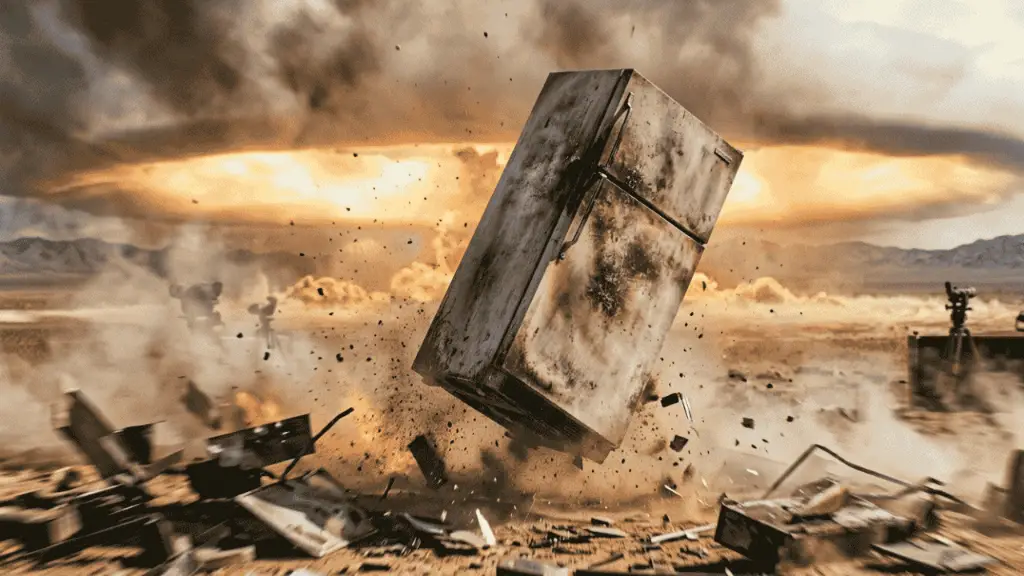
Inside, John was screaming. The sandwich was airborne. It was completely dark.
Found by the Radiation Team
Five minutes after the blast, a radiation monitoring team worked its way through the debris field, Geiger counters clicking. They found the refrigerator.
The readings were alarming. The team opened the door.
John Lively fell out — dusty, disoriented, and alive. His injuries: a bitten tongue and a bruised elbow.
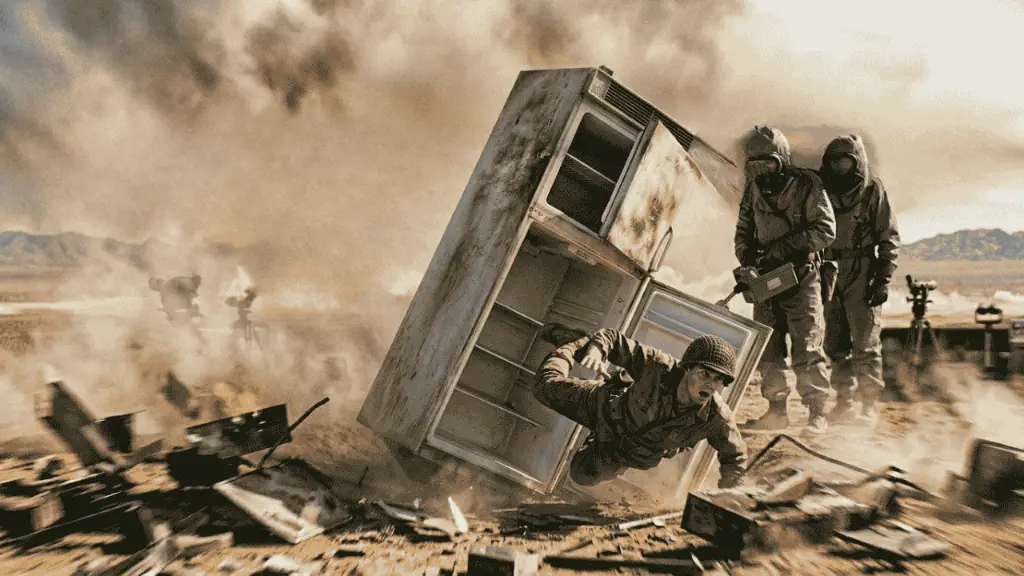
The sandwich was still cold.
“Recommend Frigidaire for Fallout Shelters”
The Army Report Nobody Expected
The Army’s official after-action report on John’s survival is one of the more surreal documents in American military history. It reads, in part:
“Subject Lively survived 37kt detonation at 1 mile in refrigeration unit. Unit sustained minor damage.”
The conclusion section — which someone in the Pentagon apparently wrote with a straight face — included the line:
“Recommend Frigidaire for fallout shelters.”
As a result of the report and the publicity that followed, Frigidaire’s stock jumped 12% the next day. Corporate America had never seen a product endorsement quite like it.
John Lively Becomes a Celebrity
Life Magazine ran a full photo spread of John standing next to his dented, battle-scarred fridge. The caption read: “Cool Under Pressure.”
The Army, naturally, wanted to replicate the experiment for science. John refused. Emphatically.
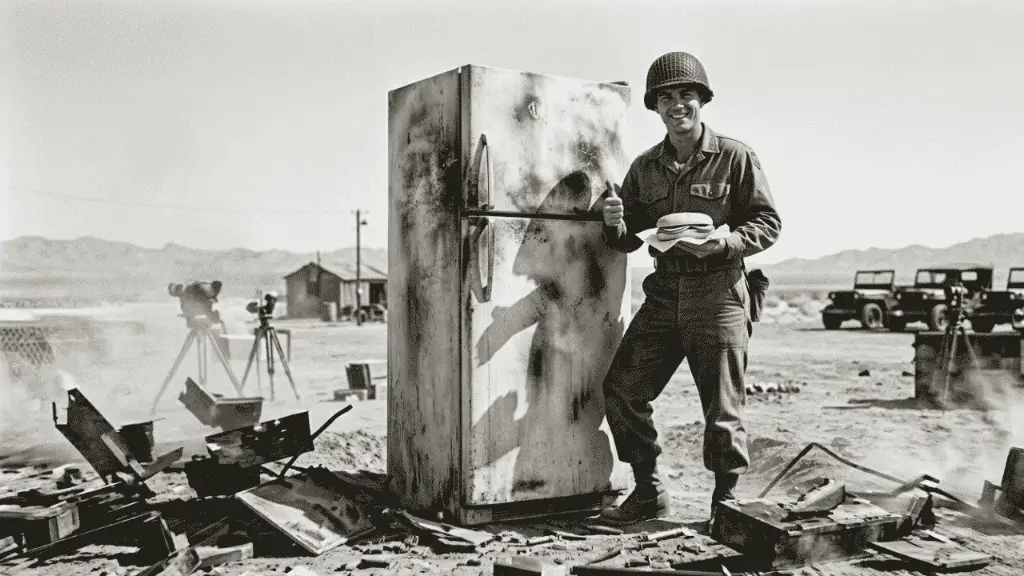
He was honorably discharged in 1959. Doctors noted he showed signs of PTSD, though interestingly, his documented triggers were more mundane than nuclear — the smell of mayonnaise reportedly bothered him for years. The atomic blast itself, he claimed, was “over too fast to be scared.”
The Fridge, the Film, and the Legacy
Indiana Jones Stole His Story
In 2008, Indiana Jones and the Kingdom of the Crystal Skull featured a scene where Indiana Jones survives a nuclear blast by hiding inside a lead-lined refrigerator. Critics immediately called the moment absurd. “Nuke the fridge” became internet shorthand for a ridiculous plot point.
Read how Hollywood misjudges Captain Jack Sparrow
John’s family had thoughts about that.
“That actually happened to Grandpa,” his granddaughter reportedly told a reporter after the film came out.
The family was, by all accounts, completely unbothered.
Where the Fridge Is Today
The refrigerator itself was recovered, decontaminated, and preserved. Today, it sits in the National Atomic Testing Museum in Las Vegas — still dented, still unmistakably itself.
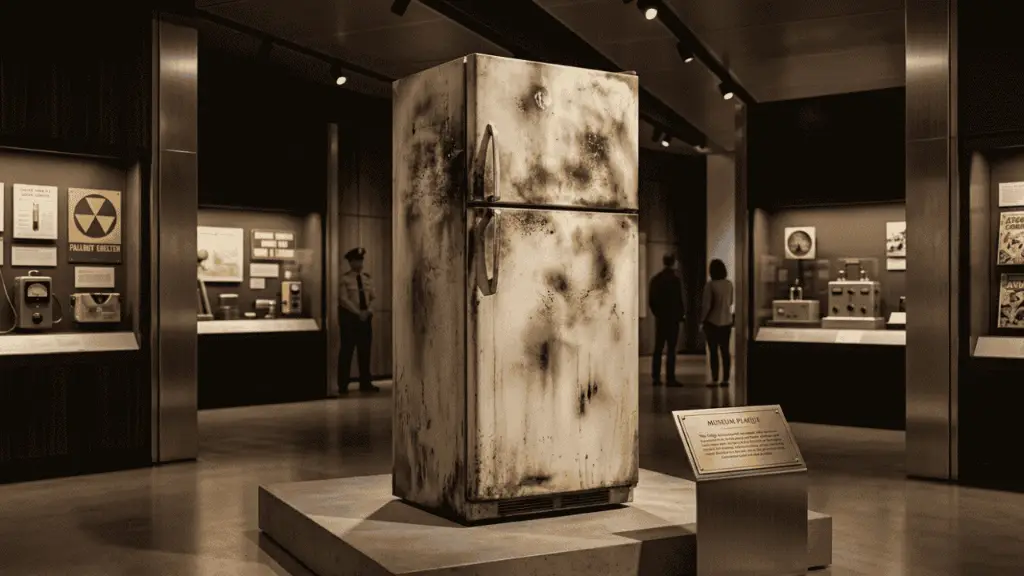
The plaque on the display reads:
“This refrigerator saved a life. Contents not included.”
John Lively’s Final Word on the Whole Thing
In a 2001 interview, John reflected on the most famous moment of his life with the measured calm of a man who had genuinely run out of things to be surprised by.
“Sandwich was still cold,” he said. “Best bologna of my life.”
John R. Lively died in 2022 at the age of 87, of old age, peacefully, and reportedly buried with a fridge magnet his grandchildren gave him.
Conclusion: The Real Nuclear Survival Story Nobody Taught You
The story of John R. Lively and the nuclear refrigerator survival at Operation Plumbbob isn’t just a quirky Cold War footnote. It’s a reminder of how chaotic, strange, and deeply human history actually is when you look past the textbooks.
A 22-year-old private made a gut call with four seconds to spare. He grabbed a bologna sandwich, climbed into a refrigerator, and survived a blast that leveled everything around him.
The Army called it a data point. The nation called him a celebrity. Indiana Jones called it a plot device.
John just called it lunch.