
Hajjaj bin Yusuf: Power, Terror, and a Haunted Legacy
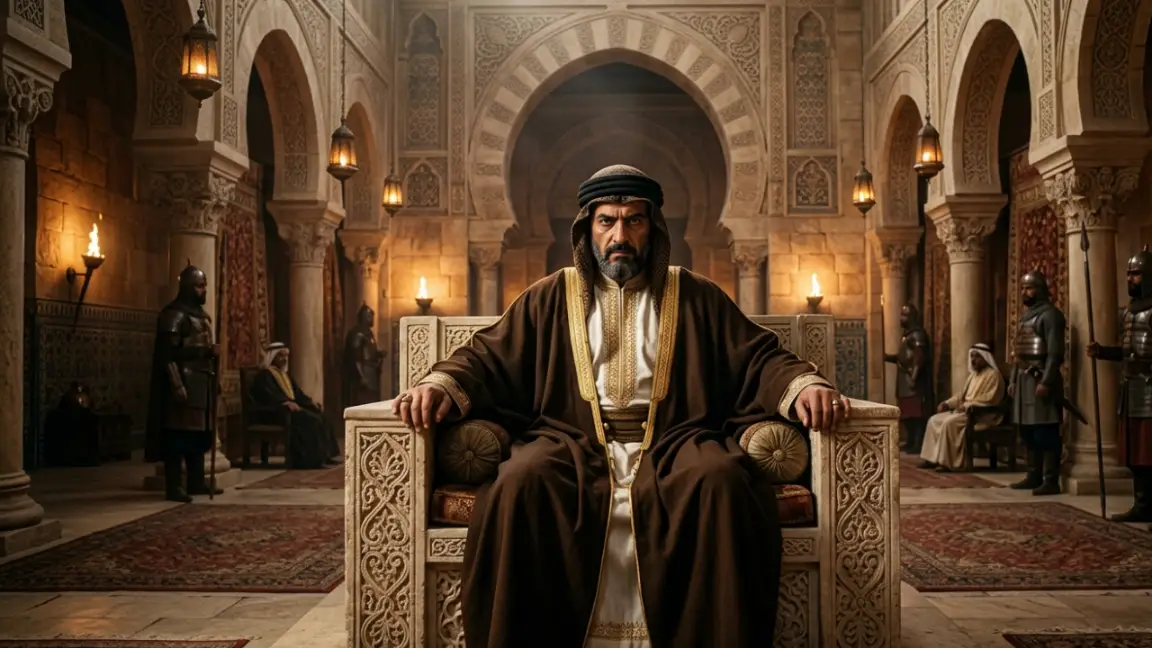
Hajjaj bin Yusuf was a prominent and controversial Umayyad governor known for his ruthless consolidation of power. He led the historic siege of Mecca, which resulted in damage to the Kaaba and the death of Abdullah bin Zubair. His early life as a teacher transitioned into a brutal military career.
As Governor of Iraq, Hajjaj maintained order through fear and executed influential scholars like Saeed bin Jubair. While he facilitated administrative reforms and military expansions into Sindh, historians primarily remember him as an oppressor. His legacy remains a cautionary study of effective administration separated from justice and moral conscience.
It was a moment no one in history had ever seen coming.
Stones were flying through the air — not toward an enemy fortress, not toward a battlefield — but toward the holiest site in Islam.
The Kaaba stood under siege.
And the man giving the orders? He was a Muslim governor, acting on the command of a Muslim caliph.
Hajjaj bin Yusuf — a name that has haunted Islamic history for over thirteen centuries. Some called him a brilliant administrator. Most called him something far darker.
Who was this man? How did a boy who once taught the Quran to children grow into one of the most feared rulers the Islamic world had ever seen? And why does his story still matter today?
Read on. The truth is more disturbing than you might expect.
From a Quiet Classroom to the Corridors of Power
A Child of Ta’if
Hajjaj bin Yusuf al-Thaqafi was born around 661 CE in the city of Ta’if.
He came from the tribe of Thaqif — the same tribe as the respected companion Uthman ibn Abi al-Aas (RA). However, historians find no solid evidence that Hajjaj himself descended from any notable companion of the Prophet ﷺ.
His father, Yusuf, was an ordinary man with no particular influence. Young Hajjaj began his early life teaching the Quran to children — a humble, even noble, beginning.
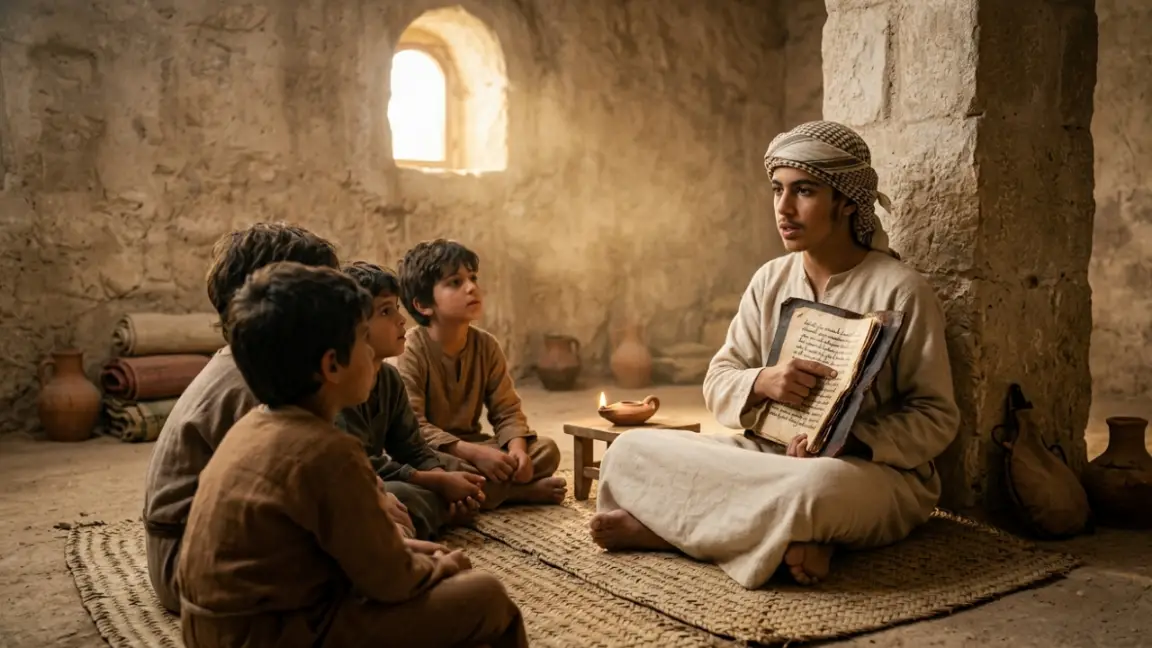
But something was hardening inside him.
The Making of a Dangerous Man
Hajjaj had an extraordinary memory. His command of the Arabic language was exceptional. And his personality carried a coldness that grew sharper with every passing year.
By the time he reached adulthood, discipline and ruthlessness had become two sides of the same coin for him. He believed that order justified any means — no matter how brutal.
Eventually, that quality caught the attention of someone very powerful.
The Caliph Who Needed a Weapon
In the late seventh century, the Islamic world was far from the unified community it is often imagined to be.
After the martyrdom of Hazrat Ali (RA) and the peace agreement of Hazrat Imam Hassan (RA), the Umayyad dynasty had taken control. The caliphate — once built on consultation and justice — was quietly becoming a monarchy.
Umayyad Caliph Abdul Malik bin Marwan faced a serious challenge. Abdullah bin Zubair (RA), son of the great companion Zubair bin al-Awwam (RA), had established a rival caliphate in Mecca. His authority stretched across Hijaz, Iraq, and several surrounding regions.
Abdul Malik had to take down this opposition, and he needed someone who wouldn’t think twice about doing whatever it took.
He chose Hajjaj bin Yusuf.

The Siege of Mecca and the Attack on the Kaaba
An Army Marches Toward the Holiest City
Hajjaj received his army and his orders. He marched toward Mecca — not as a pilgrim, but as a commander on a political mission.
What followed shocked the Muslim world.
Stones Aimed at the House of Allah
Hajjaj besieged Mecca. He positioned catapults and launched a bombardment that sent stones crashing into the sacred city. Multiple historical sources confirm that the Kaaba itself sustained damage during this assault.
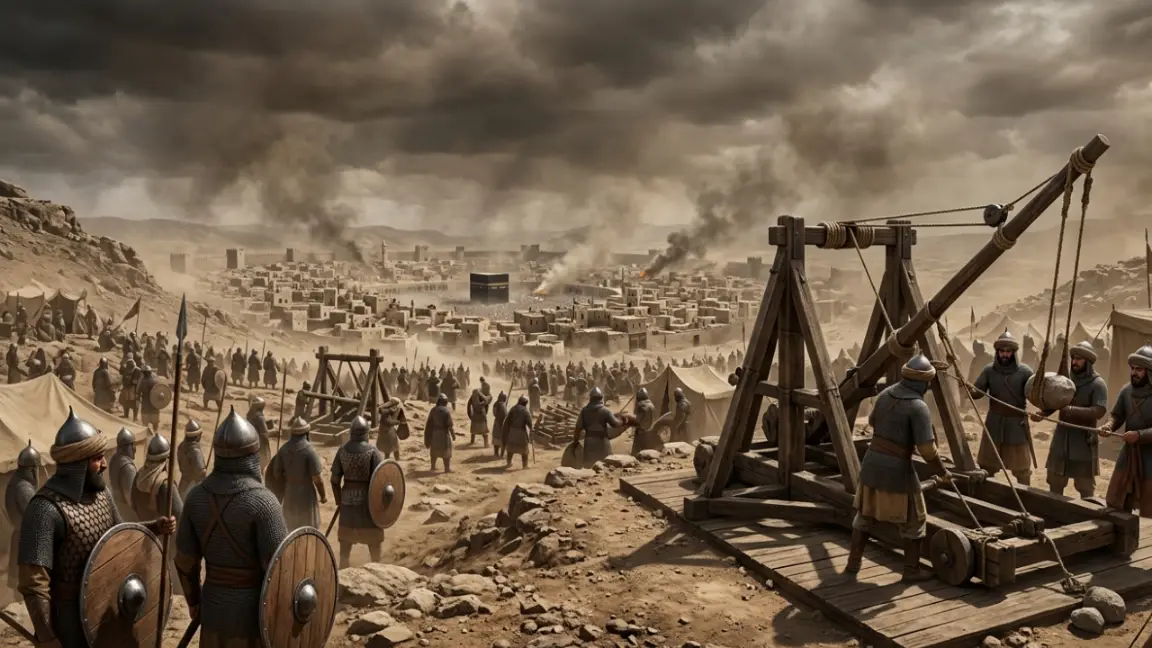
Blood was shed inside the Haram — the sanctuary where even trees were not to be cut, and animals were not to be harmed.
For many Muslims across the world, this was an unthinkable moment. Nothing like it had been seen since the early days of Islam.
The Death of Abdullah bin Zubair (RA)
In 692 CE, Abdullah bin Zubair (RA) was killed.
He wasn’t just a political opponent. He was the son of a companion of the Prophet ﷺ, a man of strong faith and remarkable bravery. For years, he stood firm in defending Mecca against immense pressure.
Hajjaj had his body hung on a crucifix — a public display designed to intimidate anyone who dared to resist.
However, one woman was not intimidated.
A Mother’s Words That Cut Like a Sword
Abdullah bin Zubair’s mother was Asma bint Abi Bakr (RA) — elderly, nearly blind, and unshakeable.
She walked to where her son’s body hung and stood before Hajjaj. Then she said:
“The rider has dismounted. But the oppressor never lasts.”
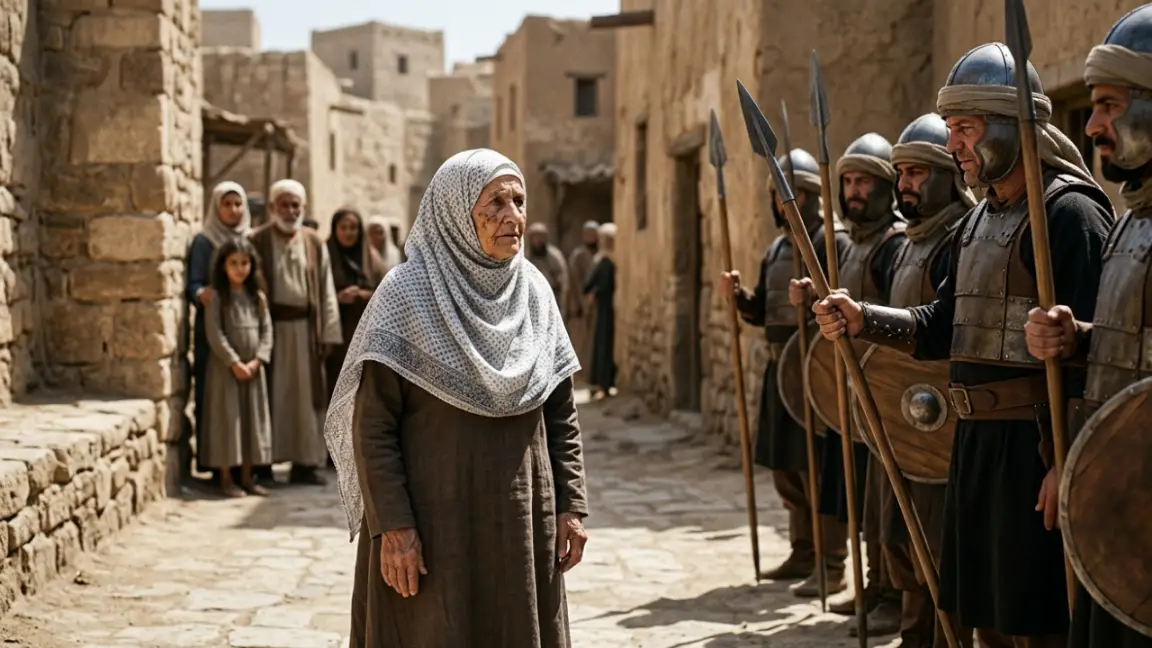
Those words outlived every stone Hajjaj ever threw.
Governor of Iraq: Where the Real Terror Began
A New Stage, A Deadlier Performance
Fresh from his “victory” in Mecca, Hajjaj bin Yusuf was appointed Governor of Iraq.
Iraq at that time was a boiling pot — full of rebellions, tribal tensions, and restless populations. Hajjaj walked into the grand mosque of Kufa, climbed the pulpit, and delivered a speech that silenced an entire city.
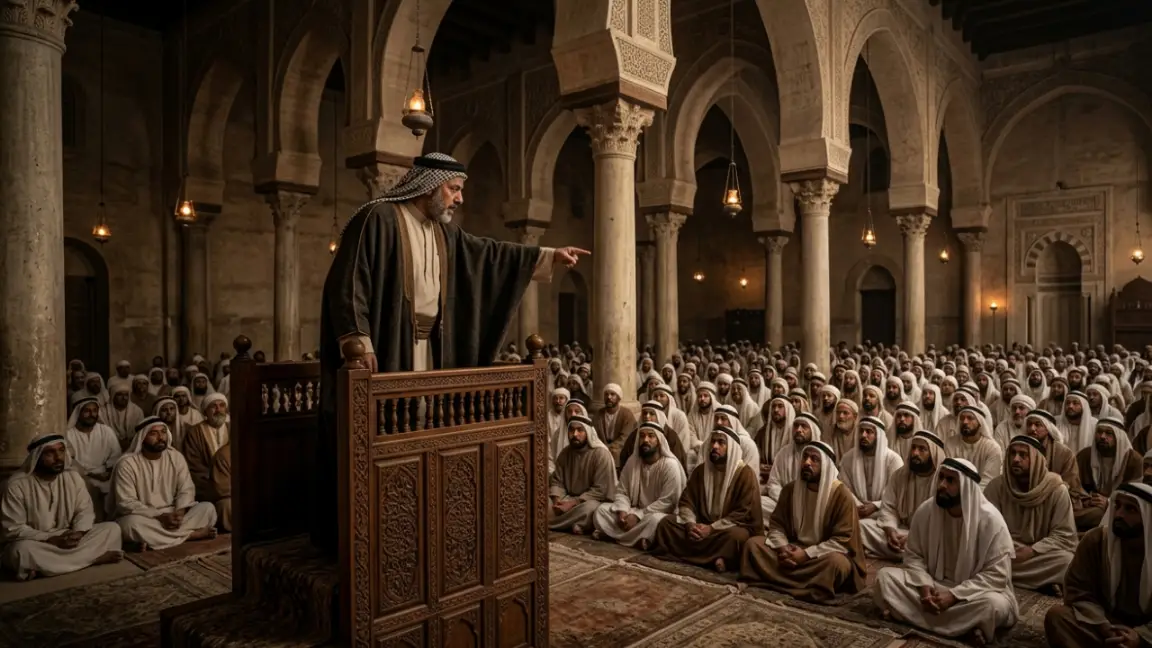
He looked out at the crowd and said:
“I see heads that are ripe and ready to be cut. And I am the man who will cut them.“
He was not speaking in metaphors.
A City Gripped by Fear
Hajjaj wasted no time establishing control. Minor signs of resistance led to arrest, flogging, or execution. Prisons filled quickly. People learned to lower their voices and avoid eye contact with his men.
Scholars like Imam al-Dhahabi and Imam Ibn Kathir documented the scale of what followed. Some accounts record that over 100,000 people were killed during his years in power — though historians debate the exact numbers.
What nobody debates is the atmosphere he created: absolute, suffocating fear.
The Scholar Who Would Not Be Silenced
Saeed bin Jubair: A Man of Rare Courage
Among all the stories from Hajjaj’s rule, one stands apart.
Saeed bin Jubair (RA) was one of the greatest scholars of his era. A student of the legendary Ibn Abbas (RA), he was known across the Islamic world for his knowledge, his piety, and his moral strength.
When Hajjaj’s crimes became impossible to ignore, Saeed bin Jubair spoke the truth — openly, fearlessly, and without apology.
Because of this, Hajjaj had him arrested.
The Final Conversation
The exchange between the two men is preserved in historical records. Saeed bin Jubair stood before the most dangerous man in the region and refused to compromise a single word of truth.
Hajjaj ordered his execution.
A Ghost That Never Left
Afterward, something unexpected happened to Hajjaj.
He could not sleep. Night after night, he was tormented by visions of the scholar he had killed. He reportedly confessed to those around him:
“Saeed bin Jubair does not let me sleep.”

The man with all the power was haunted by the man he had silenced. It is one of history’s most striking ironies — and one of its most powerful lessons.
The Young General Who Changed the Subcontinent
A Problem Far from Iraq
Meanwhile, trouble was brewing along the coast of Sindh — in the region that is now southern Pakistan.
Arab traders had been attacked. Muslim women had been taken captive. Requests for justice had gone unanswered. Hajjaj sent smaller military expeditions to respond, but they failed.
So he turned to someone he trusted completely.
Muhammad bin Qasim: Seventeen and Unstoppable
Muhammad bin Qasim was Hajjaj’s nephew and his son-in-law. Hajjaj had personally overseen his military training.
He was around seventeen years old when he led his army into Sindh. In a campaign that astonished even his own commanders, he captured Debal, Nirun, and Sehwan — and then defeated the powerful King Dahir in direct battle.
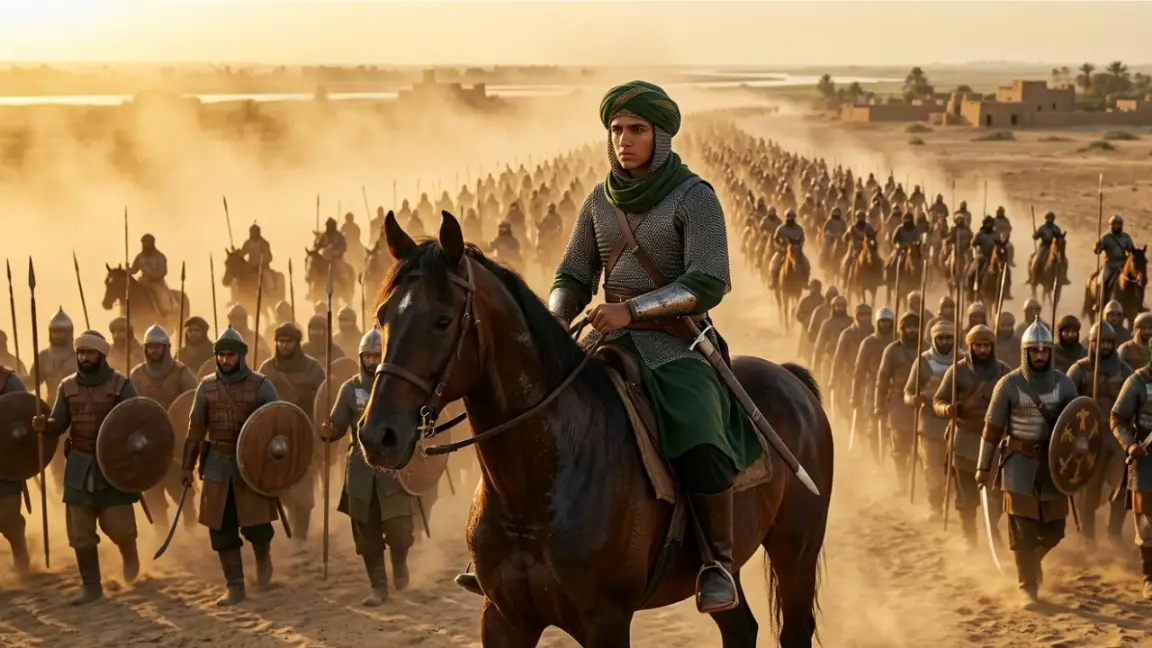
In addition to his military skill, Muhammad bin Qasim showed unexpected wisdom in governance. He offered protection to temples and local communities under fair agreements. Many people in Sindh accepted his administration because of this measured approach.
It was one of the most extraordinary military campaigns in early Islamic history — led by a teenager.
The End of Two Men
Hajjaj’s Miserable Final Days
In 714 CE, Hajjaj bin Yusuf fell gravely ill.
He suffered from a severe stomach ailment. His final days, by most accounts, were filled with physical agony and deep psychological restlessness. The man who had terrorized millions now lay helpless — tormented, sleepless, and afraid.
He died without peace.
Muhammad bin Qasim’s Tragic Fate
Shortly after Hajjaj’s death, everything changed.
When Sulaiman bin Abdul Malik became Caliph, he moved against everyone associated with Hajjaj. Muhammad bin Qasim — the young general who had carried the Islamic world into the subcontinent — was recalled.
He was brought back in chains.
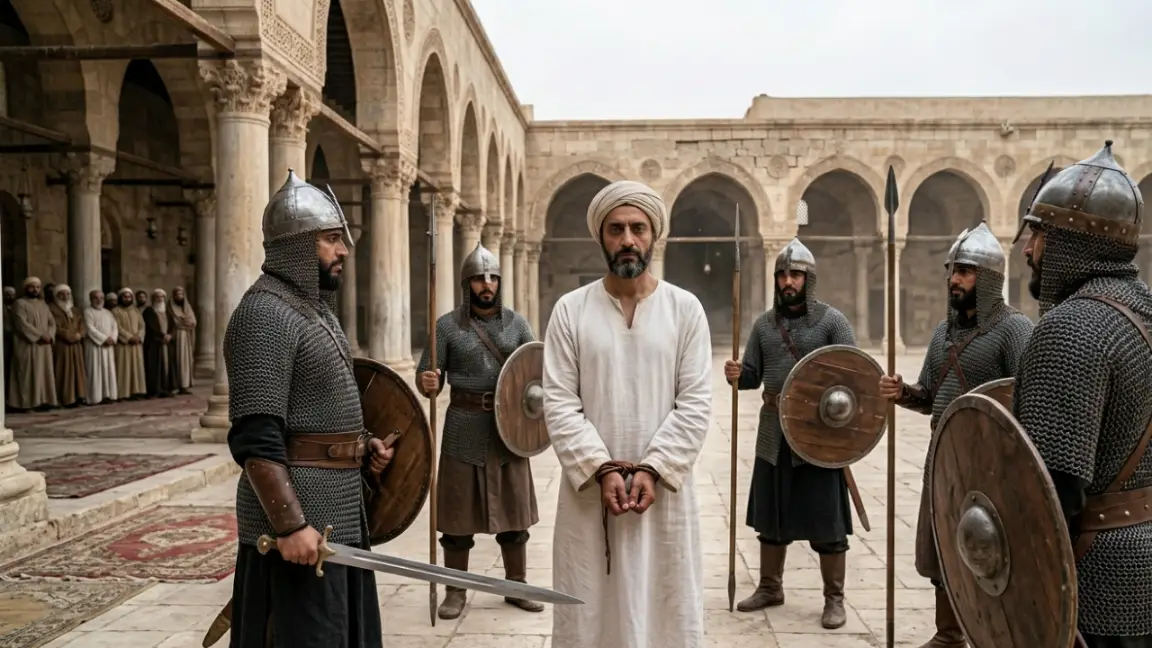
A well-known popular story claims that King Dahir’s daughters falsely accused him of dishonoring them, triggering his punishment. However, most serious historians consider this account unreliable and poorly sourced.
The more credible explanation is far simpler and far sadder: Muhammad bin Qasim was a political target. His closeness to Hajjaj made him an enemy of the new caliph. He died in captivity — a brilliant young man destroyed by the very political machinery that had created him.
The Untold Story of the Ottoman Dynasty’s Expulsion from Turkey
How History Judges Hajjaj bin Yusuf
What He Built
It would be dishonest to pretend Hajjaj contributed nothing.
During his years in power, he stabilized Umayyad rule across a fractured empire. He reinforced Arabic as the official language for administration and backed the significant effort to add diacritical marks to the Quran, making it easier for non-Arab Muslims to read it accurately.
He was, by any measure, an effective administrator.
What He Destroyed
However, effectiveness without conscience is its own kind of catastrophe.
Hajjaj attacked the Kaaba, killed the son of a companion of the Prophet ﷺ, and executed one of the greatest scholars of his time. He ruled through fear, leaving behind a legacy stained with the blood of the innocent.
Major Islamic scholars — including Imam al-Dhahabi and Imam Ibn Kathir — condemned him as a fasiq and an oppressor. His administrative record did not balance his crimes. It never could.
Conclusion: What the Story of Hajjaj bin Yusuf Still Teaches Us
Hajjaj bin Yusuf is remembered as one of the most controversial and complex figures in Islamic history.
He had intelligence, discipline, and the ear of powerful caliphs. He built systems that lasted long after him. Yet today, more than thirteen centuries later, his name is not remembered with admiration — it is remembered with a warning.
Power without justice does not age well.
Meanwhile, the scholar he executed — Saeed bin Jubair — is remembered with reverence, love, and deep respect across the Muslim world. One man had all the weapons. The other had only his integrity. History decided which one mattered more.
The story of Hajjaj bin Yusuf is not just ancient history. It is a mirror. And what it reflects is as relevant today as it was in the seventh century.