
When Doctors Sold Cigarettes: The Real History of Smoking in the 1940s and 1950s
During the 1940s and 1950s, tobacco companies used sophisticated advertising campaigns to suggest cigarettes were safe by featuring medical endorsements. Major brands utilized biased surveys and funded internal research divisions to create the appearance of scientific support, often placing these advertisements directly in respected medical journals.
The industry’s strategy faced challenges as landmark studies in 1950 established a causal link between smoking and lung cancer. Despite initial denials and public relations efforts from tobacco manufacturers, medical organizations eventually withdrew their support, leading to a 1964 government report that officially declared smoking a health risk.
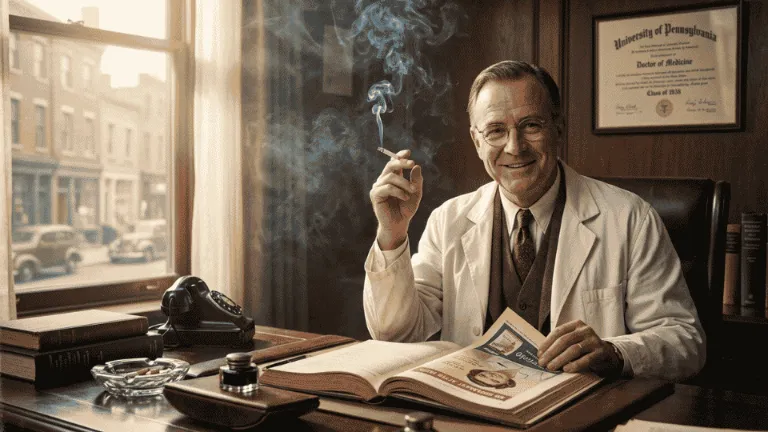
Picture this: a doctor in a white coat looks straight into the camera, lights a cigarette, and tells you it is perfectly safe.
This was not a scene from a dark comedy. This was real life in the 1940s and 1950s — and it happened on a massive, calculated scale. Cigarette advertising in this era was not just aggressive. It was one of the most sophisticated campaigns of deception the world had ever seen.
And the most disturbing part? Most people had no idea.
A World Wrapped in Smoke
In the 1940s and 1950s, cigarettes were simply everywhere.
You could smoke on airplanes, in office buildings, in hospital corridors, and in front of your television. Nobody questioned it. It was as normal as drinking a cup of coffee.
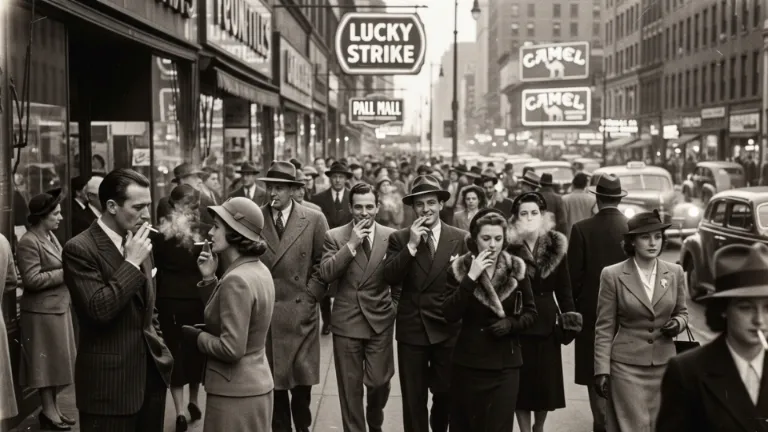
In the 1930s and 1940s, smoking had become the norm for both men and women in the United States, and a majority of physicians smoked. Meanwhile, a quiet nervousness about health risks was starting to bubble under the surface. Tobacco companies noticed. And they acted fast. PubMed Central
The Campaign That Changed Everything: “More Doctors Smoke Camels”
This is where history gets truly remarkable — and deeply troubling.
In 1946, the R.J. Reynolds Tobacco Company — producer of Camel cigarettes — launched an advertising campaign built around one instantly recognizable tagline: “More doctors smoke Camels than any other cigarette.“
The message was brilliantly simple. If your doctor chooses Camels, they must be safe.
But here is the truth behind that campaign. According to research from Stanford University, R.J. Reynolds paid to have surveys conducted at medical conventions. To skew the results, doctors were given free cigarette packets — and afterward, they were asked which brand they had in their pockets or preferred. Healthcare Administration Degree
It was not a scientific survey. It was a trick. And it worked on millions of people.
How Lucky Strike Started It All
R.J. Reynolds was not even the first company to use this strategy. That honour went to American Tobacco, the maker of Lucky Strike.
In 1930, Lucky Strike published an advertisement claiming “20,679 Physicians say ‘LUCKIES are less irritating'” to the throat. To get this number, the company’s ad agency had sent physicians cartons of Lucky Strike cigarettes and a letter asking if they thought Lucky Strikes were “less irritating to sensitive and tender throats than other cigarettes.” HISTORY
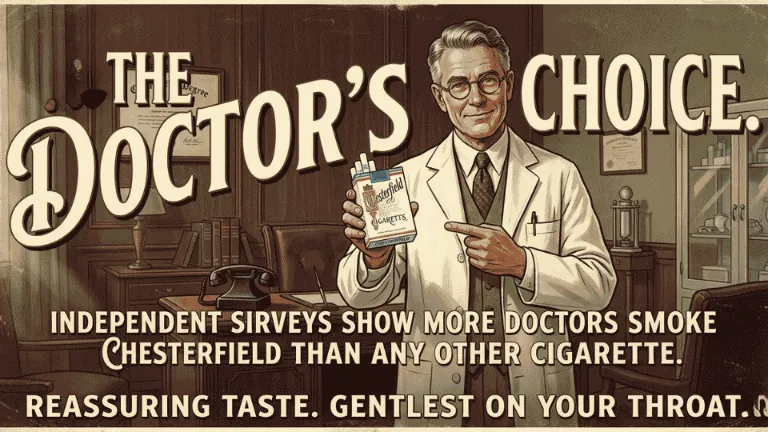
As a result, an entire medical endorsement was built on a leading, biased question — sent with free cigarettes as a gift.
Philip Morris and the Fake Research Division
Philip Morris went even further. In 1937, a Saturday Evening Post advertisement claimed that doctors had conducted a study showing “when smokers changed to Philip Morris, every case of irritation cleared completely and definitely improved” — without mentioning that Philip Morris had sponsored those very doctors. HISTORY
Meanwhile, R.J. Reynolds created something even more sinister. Reynolds established a Medical Relations Division in the early 1940s, which was actually based out of their advertising firm, not any professional scientific body. This division found researchers who could substantiate the medical claims the company was already making in advertisements. PubMed Central
In other words, they built their own fake science machine. Then they advertised those findings as independent research.
Cigarette Ads in the Most Trusted Medical Journals
The deception did not stop with newspapers and television. It reached all the way into the pages of medicine’s most respected publications.
By the 1930s, cigarette advertisements appeared regularly in medical journals — including the Journal of the American Medical Association (JAMA) and The New England Journal of Medicine in the US, and The Lancet in the United Kingdom. Until 1953, JAMA accepted cigarette advertisements that encouraged physicians to recommend certain brands to their patients. CCC

For example, a 1942 Camel advertisement ran directly in JAMA with the headline: “Scientific tests indicate that the slower-burning cigarette means less nicotine in the smoke.”
Tobacco companies also hosted dinners at fancy restaurants for throat specialists, where practitioners were encouraged to recommend cigarette brands to patients with coughs and other complaints. Healthcare Administration Degree
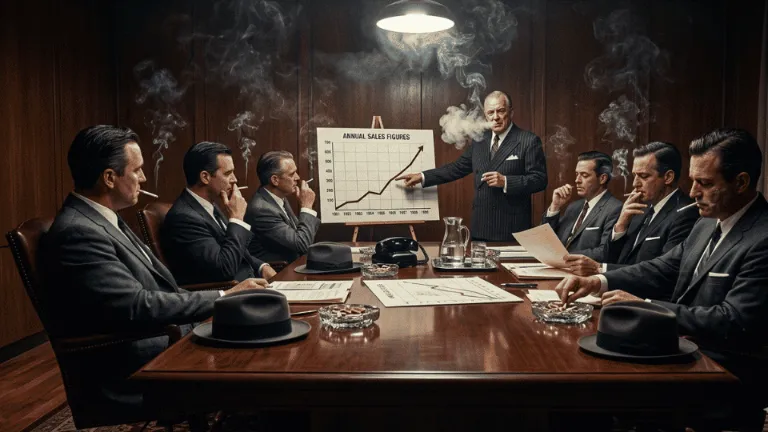
This was not accidental. It was a deliberate strategy to capture medical authority from the inside.
The Medical Student Who Saw the Truth
While all of this was happening, one young man was quietly about to change history.
Ernst Wynder was a medical student when he came up with the idea to link smoking with cancer, after witnessing the blackened lungs of a man who had died of lung cancer. That moment planted a seed that would eventually crack the entire tobacco industry open. Wikipedia

In 1950, Wynder and Graham in the United States and Doll and Hill in England published landmark case-control studies that implicated tobacco use as a major risk factor for lung cancer. NCBI
The Doll and Hill study, published in the British Medical Journal, provided a level of certainty about the causal link that had been missing from all previous research. Oncopedia
However, 1950 should have been a turning point. It was not.
The Industry Fights Back: The “Frank Statement” of 1954
The tobacco companies read those studies. They understood exactly what was coming.
In January 1954, tobacco manufacturers jointly published “A Frank Statement to Cigarette Smokers” — a full-page advertisement that appeared in 448 newspapers across 258 cities, reaching over 43 million Americans. American Association for Cancer Research
The advertisement was carefully worded to counteract the published studies linking cigarettes to disease — and to convince the public that the tobacco industry was actively trying to solve the problem. SourceWatch
Their message to millions of readers was chilling in its false confidence:
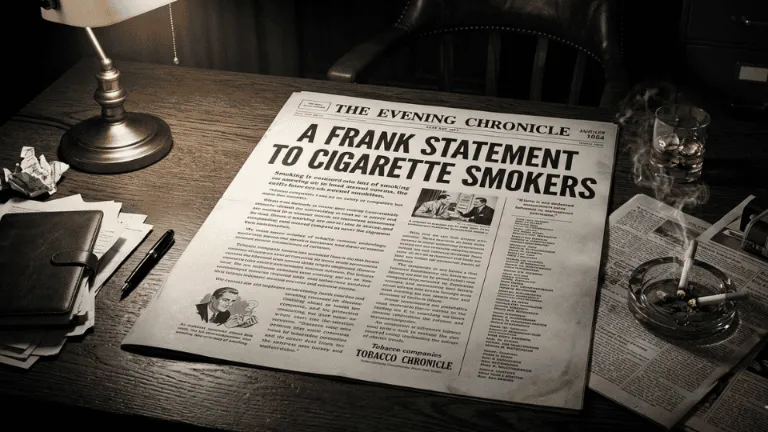
“We believe the products we make are not injurious to health.” And: “There is no proof that cigarette smoking is one of the causes” of lung cancer. Expo Tobacco
However, internal tobacco documents later revealed that many scientists within the industry had already acknowledged as early as the 1950s that cigarette smoking was unsafe. PubMed
They knew. They published the denial anyway.
The Walls Finally Begin to Crack
By 1953, JAMA banned tobacco advertisements from its pages and from AMA conventions. Physicians were slowly waking up. A study published in The New England Journal of Medicine found that the number of doctors in Massachusetts who smoked regularly dropped from 52% in 1954 to 39% just five years later. Healio
After running for eight years, the R.J. Reynolds “More Doctors” campaign finally ended in 1954. The doctor in the white coat quietly disappeared from cigarette advertisements.
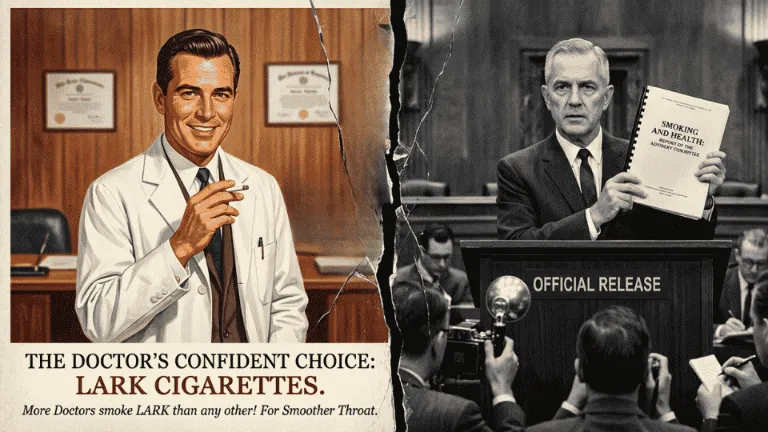
Eventually, the science became impossible to ignore. In 1964, the U.S. Surgeon General released a landmark report that officially declared smoking a cause of lung cancer. It changed public health policy forever. Tobacco advertising on television and radio was banned in 1971.
What This History Really Means
The story of cigarette advertising in the 1940s and 1950s is not just a history lesson. It is a masterclass in how trust, authority, and science can all be weaponized by those with enough money and motive.
Tobacco companies did not just sell cigarettes. They sold certainty. They bought doctors, funded fake research, printed lies in medical journals, and reached 43 million people in a single newspaper ad to protect their profits.
Because of this, millions of people smoked for decades without ever knowing the real risk.
Conclusion
The 1940s and 1950s cigarette advertising era stands as one of the most disturbing examples of corporate deception in modern history. From Lucky Strike’s 20,679 phantom-physician endorsements to the audacious “Frank Statement” that denied links to cancer while executives privately knew the truth — every piece of it was engineered to keep the public in the dark.
Ernst Wynder’s blackened lung. Richard Doll’s meticulous research. The 1964 Surgeon General’s report. These were the moments that science finally fought back.
History remembers those who told the truth. It also remembers those who paid to bury it.