
The Surgeon Who Transplanted Goat Testicles to Humans
John R. Brinkley rose to prominence in the early 20th century by performing fraudulent goat testicle transplants. Despite the lack of medical efficacy, he built a massive financial empire through radio broadcasting and aggressive marketing. His career blended medical quackery with pioneering media strategies to exploit desperate, vulnerable patients.
Brinkley’s influence eventually waned following a legal battle with the American Medical Association. A failed defamation lawsuit revealed his deceptive practices and multiple patient deaths. This led to financial ruin, the closure of his powerful radio stations, and his death in 1942, leaving a legacy of medical malpractice.
In 1917, a desperate Kansas farmer walked into a small-town doctor’s office with a problem he couldn’t solve. He had tried everything. Spent a fortune on treatments. Seen doctor after doctor.
Nothing worked.
“It’s like a flat tire,” he told the physician.

What happened next would launch one of the most bizarre medical careers in American history — a story of quackery, ambition, radio empires, and a man who convinced thousands that the answer to their most intimate problems was hiding inside a goat.
A Doctor Arrives in a Dying Town
Dr. John R. Brinkley had not planned to end up in Milford, Kansas. He responded to a newspaper advertisement seeking a doctor for a town with a population of two thousand.
When he arrived, he found two hundred.
Milford had no paved roads, no electricity, and no proper water or sanitation system. It was a forgotten place — exactly the kind of town a man with only $23 in his pocket and a mountain of debt couldn’t afford to turn down.

His wife, Minnie Telitha, wept when she found out where they were going.
Brinkley’s path to medicine had been anything but conventional. At twenty-two, he was performing in traveling shows with his first wife — singing, dancing, and selling patent remedies from the back of a wagon.
In 1913, he partnered with an associate to treat male sexual weakness, but authorities shut the clinic down within two months. He was practicing without a valid license and briefly ended up behind bars.
Later, he took a job as a doctor at a meatpacking plant. It was there, watching goats brought in for slaughter, that an idea quietly took root.
He noticed their relentless sexual energy. He didn’t forget it.
By the time he reached Milford, Brinkley held a medical degree — though its legitimacy was widely questioned — and active licenses to practice in eight U.S. states. He had also earned genuine goodwill during the 1917–18 flu epidemic by tirelessly caring for patients when few others would.
He was building trust. And soon, he would use it.
The Operation No One Was Supposed to Know About
The Kansas farmer’s suggestion was simple and outrageous: What if you just gave me a goat’s testicles?
Brinkley warned him it could be fatal. The farmer said he’d take that chance.
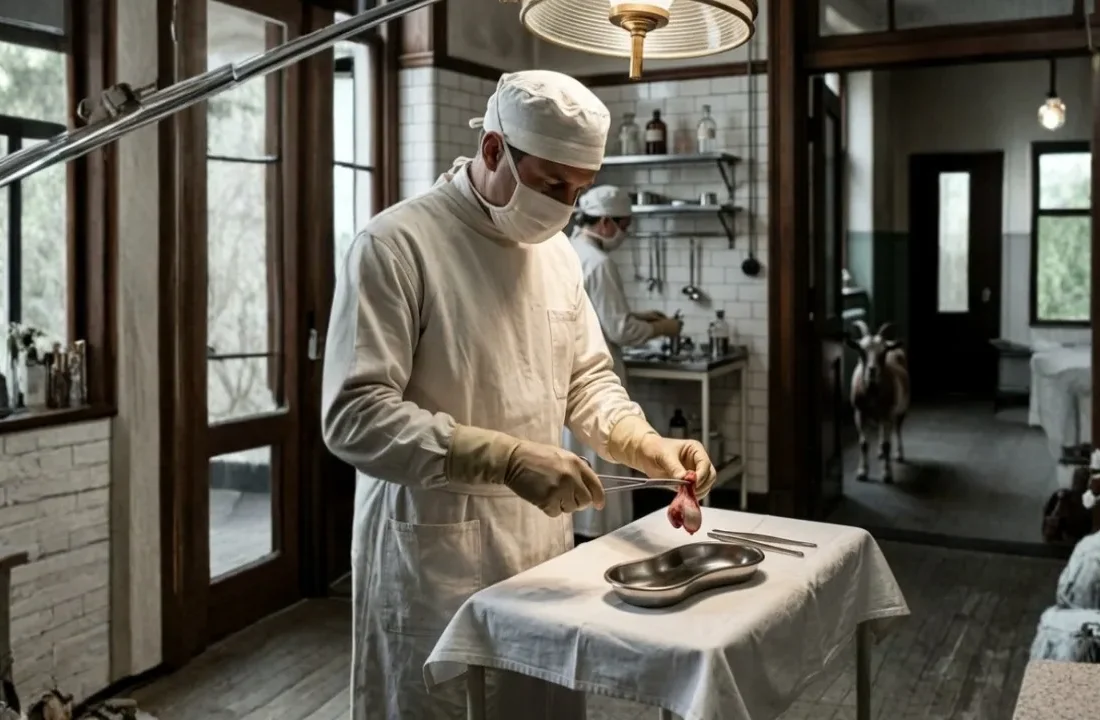
They agreed to absolute secrecy. The farmer came under the cover of darkness, bringing his own goat. The operation was performed before dawn.
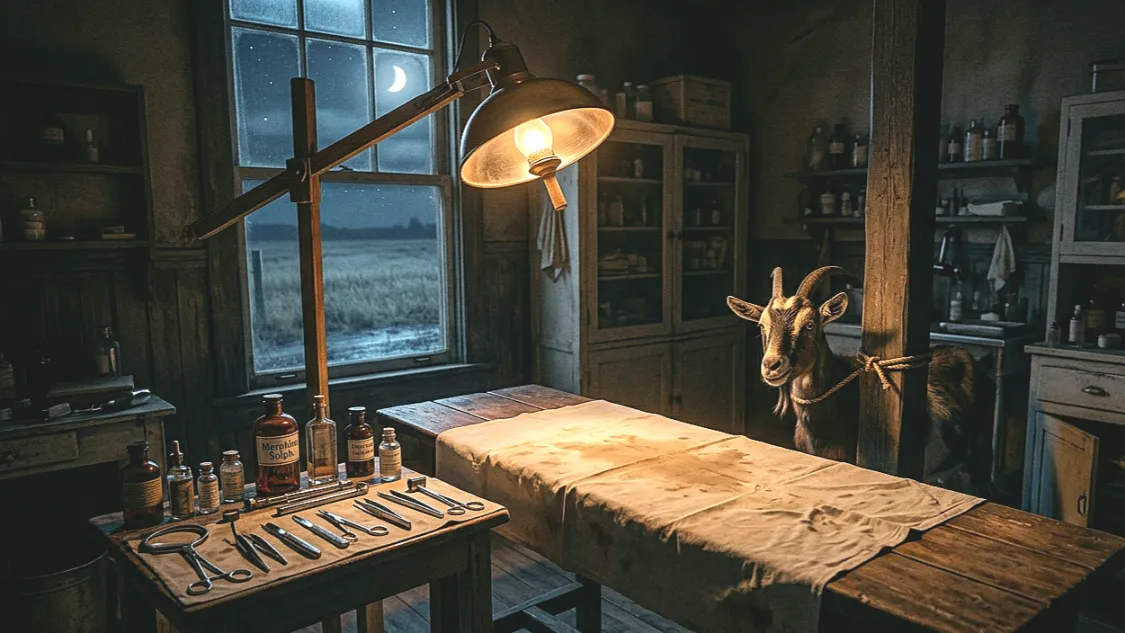
His wife was told to visit the next day, only to report whether her husband had developed a fever. Two weeks later, the farmer returned — not with a fever, but with a check for $150. According to his biography, he told Brinkley he would have paid ten times that amount.
Despite every precaution, word got out.
A second patient arrived. Then another. One of them, William Stittsworth, was reportedly so satisfied with his results that he arranged for a similar procedure to be performed on his maid, transplanting goat ovaries. The woman later became pregnant, and the child was named Billy.
Medically, the pregnancy had nothing to do with the goat tissue. But the story spread anyway — through gossip, then newspapers, then books. In an era before widespread scientific literacy, the line between miracle and myth was dangerously thin.
Was Any of This Real?
Every detail of this story is historically documented. Brinkley was a real doctor. The operations were real. The patients were real, and thousands of them genuinely believed they had been cured. But the goat tissue itself? It did nothing.
The moment Brinkley inserted foreign animal tissue into a human body, the immune system quietly destroyed it. The goat testicles were absorbed and discarded by the body within weeks. No integration. No function. No miracle. So why did so many men swear they felt transformed?
Three reasons explain it.
1st, the placebo effect. When a person truly believes a treatment will work, the brain triggers real physiological responses — energy returns, confidence surges, and symptoms that were partly psychological begin to fade. The belief itself was doing the healing.
2nd, sexual dysfunction in that era was deeply psychological. Stress, shame, and anxiety were driving most of these men’s problems. The act of doing something — traveling to a clinic, undergoing surgery, paying $750 — was enough to shift their mental state entirely.
3rd, no one wanted to admit it hadn’t worked. A man who had told his friends and family he was going to Kansas for a miracle operation was not going to come home and confess failure.
Brinkley didn’t discover a cure. He discovered something more powerful — the precise point where desperation meets belief. And he built a fortune there.

How the Goat Gland Doctor Built an Empire
As word of Brinkley’s procedures spread, the patients kept coming. And the money followed.
J.J. Tobias, Dean of the School of Law at the University of Chicago, wrote glowingly about his experience: he claimed to have entered Milford as a tired old man and left seven days later feeling twenty-five years younger.
Brinkley wasn’t just treating erectile dysfunction anymore. He was selling youth itself.
By 1921, Sidney B. Flower, writing about Brinkley’s transplantation work, described it as treating conditions that medicine had previously declared incurable — something, he noted, that had never happened before in recorded history.
With patients flooding in and money accumulating, Brinkley built a proper hospital in Milford. The turning point for his national reach came during a visit to Los Angeles, where Harry Chandler, the wealthy owner of the Los Angeles Times, became a patient and enthusiastic supporter.
Chandler praised Brinkley in his newspaper. The resulting flood of new patients gave Brinkley the resources to do something that would change everything.
He built a radio station.
The Voice Behind the Signal
Brinkley’s station quickly became one of the most popular in America.
It broadcast music, news, comedy, and poetry. But its most powerful programming was the medical shows Brinkley hosted himself — intimate, conversational, and centered almost entirely on sex.
Listeners trusted him. He spoke to them like a neighbor, not a physician.

Soon, he began prescribing treatments over the air. Patients didn’t need to visit Milford. They could write in describing their symptoms, and Brinkley would diagnose them on the radio, recommending numbered remedies that a network of pharmacists, bound to Brinkley through profitable agreements, stood ready to sell.
Meanwhile, other doctors watched their patient lists shrink.
The American Medical Association took notice. Morris Fishbein, editor of the Journal of the American Medical Association, had been watching Brinkley for years. He described him as a man of deeply unsuitable character who had weaponized the radio to extract money from the vulnerable.
Brinkley’s response was characteristically confident: he couldn’t let one unhappy patient outweigh ten satisfied ones.

Licenses Revoked, Borders Crossed
In 1930, the Kansas Medical Board revoked Brinkley’s license, citing unprofessional conduct. The Federal Radio Commission cancelled his station’s license shortly afterward.
But Brinkley didn’t disappear. He ran for Governor of Kansas as an independent candidate. His name wasn’t on the ballot — voters had to write it in themselves — and the state’s Attorney General ruled that only ballots with the name spelled correctly would count.
He didn’t win. But he came remarkably close.
Then came an offer from across the Rio Grande.
A powerful broadcaster invited Brinkley to establish a new radio station in Mexico, just across the U.S. border. Operating under Mexican broadcasting regulations, the station was granted a license to transmit at 500,000 watts — making it the most powerful radio station in the world at that time.

AM frequencies carry over vast distances, especially at night. Brinkley’s signal reached virtually every corner of North America.
The station offered what mainstream American radio wouldn’t touch: uninhibited content about sex, religion, and medicine. It was the first major border-blaster station — and it had no American regulator to answer to.
For a time, it seemed like nothing could stop him.
The Trial That Brought It All Down
Pride, in the end, was Brinkley’s undoing.
In 1938, Fishbein published a sharp new attack on Brinkley titled “Bags on Their Tops.” He wrote that Brinkley had brazenly stripped money from ordinary Americans through false promises and dangerous procedures.
Brinkley sued for defamation. It was a catastrophic miscalculation.
In a courtroom, he couldn’t rely on crowd loyalty or radio charisma. Former patients took the stand against him. They described their suffering, their financial losses, and the lives that had been damaged or destroyed.

Evidence was presented that forty-two patients had died on Brinkley’s operating table.
Under cross-examination, Brinkley was forced to admit that he knew goat testicles alone could not restore sexual function — and that his claims had been false.
Fishbein’s attorney summarized the case with brutal clarity: Brinkley was the richest surgeon in the world because he understood human weakness, and he had built a fortune on exploiting it.
The court ruled in Fishbein’s favor.
Brinkley appealed. The higher court upheld the verdict, finding that he had violated accepted standards of medical ethics and bore serious responsibility for the harm caused.
The Fake Doctor Who Saved 7,000 Babies
The End of the Goat Gland Doctor
After the verdict, the lawsuits multiplied. Mexico shut down his border radio station. His assets were seized. His fortune evaporated.
In 1941, Dr. John R. Brinkley declared bankruptcy.
The man who had once owned a fleet of yachts, a private airplane, and multiple mansions was financially destroyed. His health collapsed under the weight of legal battles and personal ruin.
He died on May 26, 1942, at the age of fifty-six.

The story of the Goat Gland Doctor is not simply a tale of a con man. It’s a portrait of what happens when ambition has no ethical foundation — when charisma replaces competence, and when desperate patients become easy targets.
Brinkley understood one thing with genuine brilliance: people will believe what they desperately want to believe. He built an empire on that understanding.
And when it collapsed, he took it — and too many of his patients — down with him.