

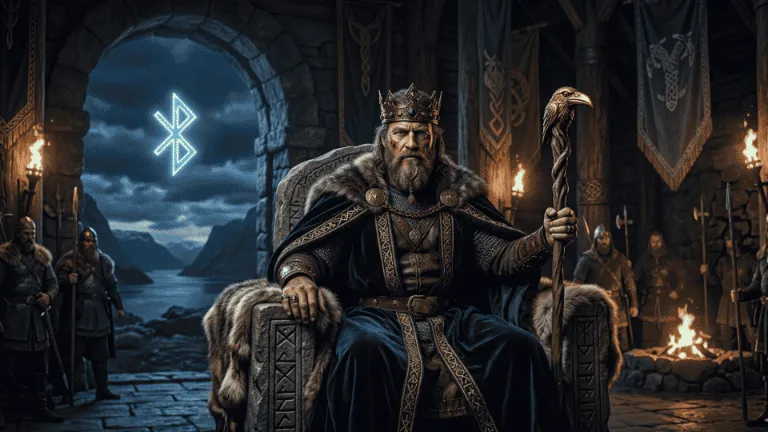
Why Is It Called Bluetooth? The Surprising Story Behind the Name
Have you ever wondered why one of the world’s most widely used wireless technologies carries such an unusual name? The origin of the Bluetooth name has nothing to do with circuit boards or radio signals. Instead, it reaches back over a thousand years — to a Viking king with a famously discolored tooth.

It is one of tech history’s best-kept secrets. And once you know it, you will never look at that little blue icon the same way again.
The Viking King Who Started It All
Back in the 10th century, a powerful Scandinavian ruler named Harald Gormsson governed Denmark and Norway. History remembers him as Harald Bluetooth — a king who accomplished something remarkable for his time.
Harald united dozens of warring, fractured Scandinavian tribes under a single banner. He did not conquer them by brute force alone. Instead, he brought rival groups together through diplomacy, strategy, and sheer will. His greatest achievement was unification.

That legacy of connection would eventually inspire a name heard by billions of people every day.
So, Why Was He Called “Bluetooth”?
This is where the story gets genuinely interesting.
Historical accounts suggest that King Harald had one dead or decaying tooth that had turned a dark shade of blue-grey. This discoloration gave him his distinctive nickname — Blåtand in Old Norse, which translates directly to “Bluetooth” in English.

Some historians offer a slightly tastier explanation. They believe Harald had a deep love for blueberries, and eating them so frequently stained his teeth a visible blue. Whether it was dental decay or blueberry obsession, the name stuck — and it stuck for centuries.
How a Medieval Nickname Became a Tech Brand
Fast-forward to the 1990s. Engineers at Ericsson, Intel, Nokia, and Toshiba were working to develop a universal short-range wireless communication standard. They needed something that could connect computers, mobile phones, and other devices seamlessly — without the chaos of multiple competing systems.
Meanwhile, Jim Kardach, one of the engineers involved in the project, was reading a historical novel about the Vikings. He came across the story of Harald Bluetooth — a king who famously unified different peoples under one kingdom. The parallel hit him immediately.

Just as Harald had united scattered tribes, this new technology aimed to unite scattered devices. The metaphor was perfect.
Kardach proposed “Bluetooth” as a working code name for the project. Everyone agreed it captured the spirit of what they were building.
The Name That Was Never Meant to Stay
Here is the twist most people do not know.
Bluetooth was never supposed to be the final name. Kardach and his team fully intended to replace it with a proper marketing name before launch. Two strong candidates emerged: “PAN” (short for Personal Area Network) and “RadioWire.”
However, both names ran into legal complications. Trademarks, copyright conflicts, and registration issues blocked both options. As a result, the team faced a deadline with no approved name on the table.
In a rush, they fell back on the old code name. “Bluetooth” became official — almost by accident.

Eventually, it spread across the entire world. Today, billions of devices carry that name and that logo, all thanks to a last-minute decision made under pressure.
The Logo Hides a Secret Too
The Bluetooth logo is not just a random design. It actually contains a hidden historical signature.
The symbol combines two ancient Norse runic letters — the runic equivalent of H (ᚼ) and B (ᛒ) — representing Harald Bluetooth’s initials. Designers merged them into a single elegant mark, which became one of the most recognized icons in modern technology.
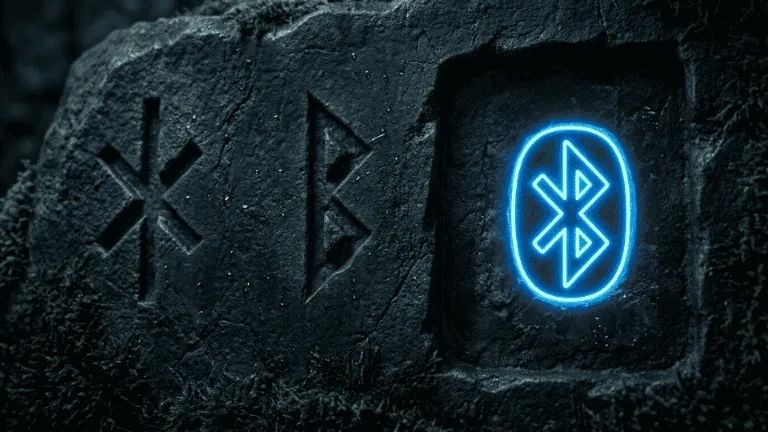
In other words, every time you tap the Bluetooth symbol on your phone, you are looking at a thousand-year-old king’s monogram.
A Name That Perfectly Fits Its Purpose
What makes the Bluetooth name origin story so satisfying is how well the metaphor holds up.
King Harald unified the people. Bluetooth technology unifies devices. The name is not just a quirky historical accident — it is a surprisingly accurate description of what the technology actually does.
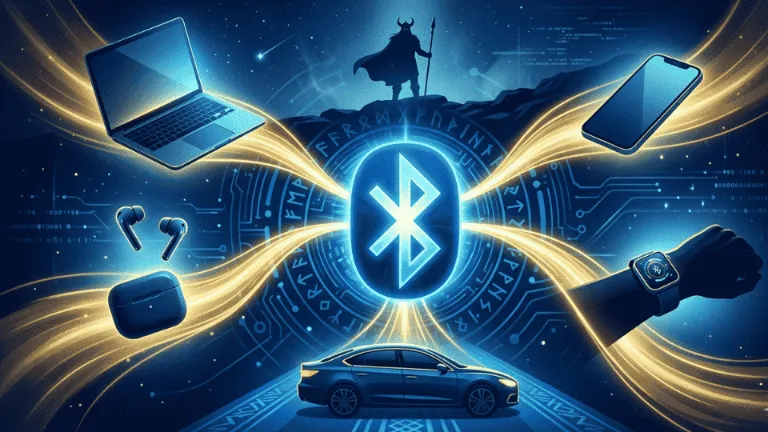
For example, your wireless earbuds, your car’s audio system, your keyboard, your smartwatch — Bluetooth quietly connects all of them. It removes barriers between devices, just as Harald once removed barriers between tribes.
Conclusion: A King’s Legacy Lives in Every Connection
The story of Bluetooth is a reminder that history hides in the most unexpected places. A Viking king’s discolored tooth — or his blueberry habit, depending on who you believe — gave a name to technology that now touches nearly every corner of the modern world.
The Bluetooth name origin is more than a fun fact. It is proof that great ideas often carry the DNA of history inside them. Every wireless connection you make today echoes a medieval king’s greatest achievement: bringing divided things together.
Next time your devices pair up without a wire, take a moment to appreciate Harald Bluetooth — the original connector.