
The Dancing Plague of 1518: When an Entire City Lost Control of Its Own Body
Imagine watching your neighbor step outside and start dancing — alone, without music, without reason. Now imagine that within days, dozens follow. Then hundreds. And nobody can stop.
That is exactly what happened in Strasbourg, France, in July 1518. The event, known today as the Dancing Plague of 1518, remains one of the strangest and most haunting episodes in recorded history. It wasn’t a festival. It wasn’t a celebration. It was a crisis — one that killed people and left historians baffled for centuries.
How It All Began: One Woman, One Street, No Explanation
It started with a single woman.
Her name was Frau Troffea. One ordinary summer day, she walked out onto a Strasbourg street and began to dance. No music. No crowd. No apparent reason. She just danced — and she couldn’t stop.
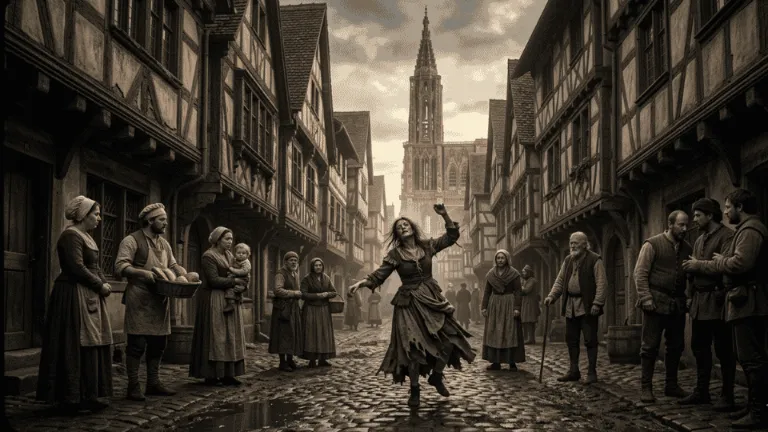
Hours passed. Then a full day. Then another.
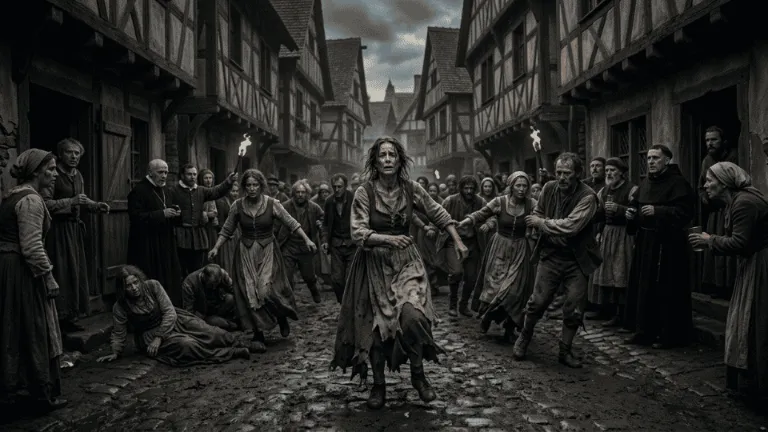
People watched in confusion. Some may have laughed at first. However, the laughter faded quickly when others joined her. One by one, then in groups, residents of Strasbourg began dancing in the streets. Within days, the number climbed to dozens. Eventually, it reached nearly 400 people.
Not a Celebration — A Living Nightmare
This was not joy. This was suffering.
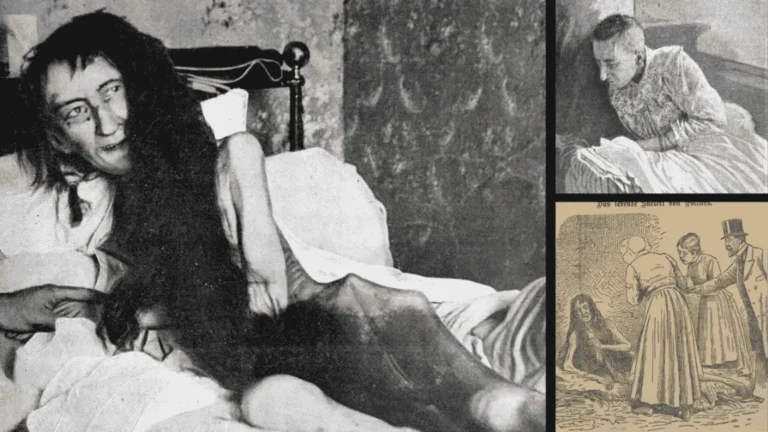
Look closely at the historical accounts, and what you see is deeply disturbing. The dancers’ faces weren’t lit with happiness — they were twisted in pain. Their feet were bleeding and broken. Their bodies were exhausted beyond human limits. And yet, they could not stop moving.
For days, then weeks, the dancing continued. People collapsed from exhaustion, heat, and dehydration. Some suffered heart attacks. Others experienced strokes. Several people died — not from any wound or visible illness, but simply from the relentless, unstoppable movement of their own bodies.
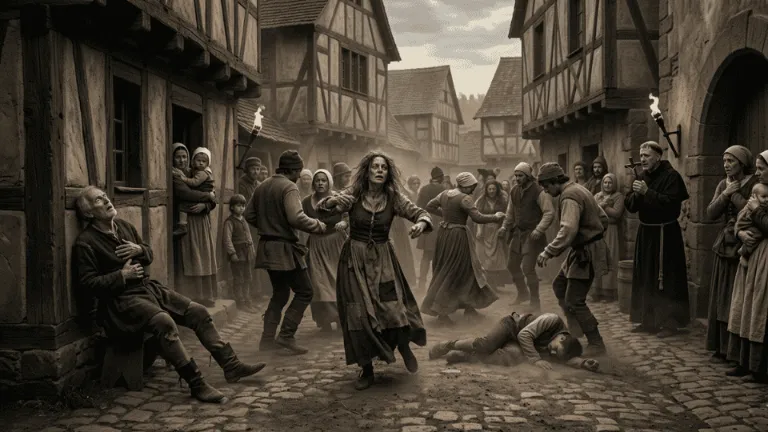
The Dancing Plague of 1518 lasted for over a month. And no one — not the city’s doctors, not its priests, not its leaders — could explain what was happening.
What Did the Authorities Do?
The city’s response makes the story even stranger.
At first, local physicians ruled out supernatural causes. They suggested the dancing was the result of “hot blood” — a medical concept from that era. Because of this diagnosis, city officials made a decision that seems almost unbelievable today: they encouraged the dancing.
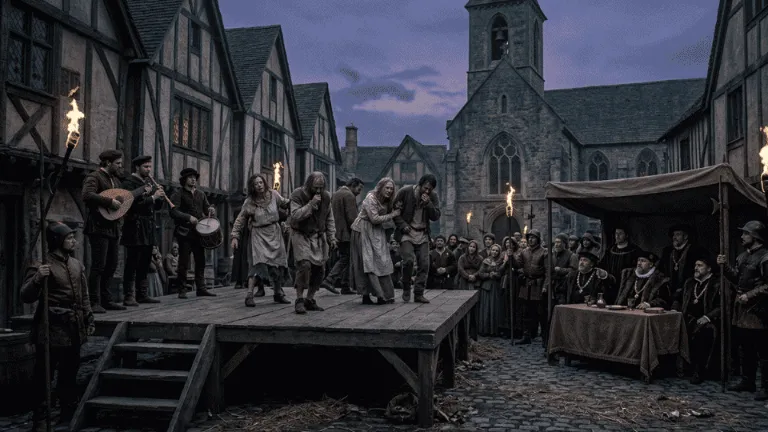
They hired musicians to play. They cleared open spaces. They even brought in professional dancers, hoping that letting the affected people exhaust themselves would eventually break the spell.
It didn’t work. The dancing only spread further.
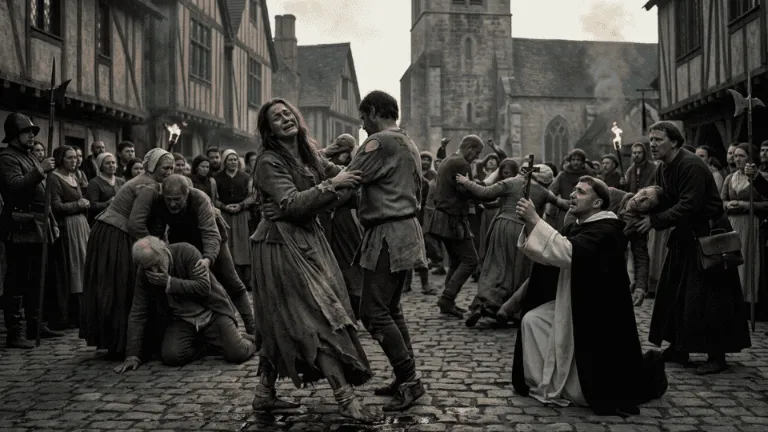
Meanwhile, the Church offered its own solution. Religious authorities declared the outbreak a punishment from Saint Vitus and encouraged sufferers to pray and make pilgrimages. Shrines were set up. People were sent to worship. Afterward, some reportedly recovered — though historians debate whether those recoveries were genuine or simply the natural end of the episode.
The Scientific Explanation: Mass Psychogenic Illness
Modern science offers a much more grounded answer. What happened in Strasbourg in 1518 is now classified as Mass Psychogenic Illness (MPI) — sometimes also called mass hysteria or mass sociogenic illness.
In simple terms, MPI occurs when a group of people begins experiencing real physical symptoms — symptoms with no identifiable biological cause — triggered by shared psychological stress. The symptoms are not fake. The pain is real. The paralysis is real. The physical breakdown is real. However, the origin is psychological, not physical.
Historians and medical researchers point to the devastating conditions of life in Strasbourg at that time:
- Widespread famine had left much of the population hungry and malnourished.
- Deadly epidemics were sweeping through Europe, and fear of disease was constant.
- Extreme poverty had pushed ordinary people to the edge of survival.
- Religious anxiety was intense — many believed they were living through divine punishment.
For example, records from the period show that the years leading up to 1518 brought catastrophic harvests and waves of syphilis and plague through the region. People were not just poor — they were terrified, hopeless, and mentally shattered.
As a result, the human nervous system — already pushed far beyond its limits — finally broke down. Not individually, but collectively. The stress erupted outward in the only way the mind could express it: through the body.
Why Did It Spread So Fast?
One of the most fascinating aspects of the Dancing Plague of 1518 is how rapidly it spread through the population.
This is where the concept of social contagion becomes important. Human beings are deeply wired to mirror one another — especially in times of fear and uncertainty. When people are already anxious, and they witness others behaving extremely, the brain can adopt those behaviors as a kind of unconscious response.
In addition, the cultural context mattered enormously. Medieval Europeans genuinely believed in curses, divine punishment, and the power of saints to afflict sinners with uncontrollable movement. When Frau Troffea started dancing, her community didn’t immediately think she was having a mental breakdown. Many believed she was cursed — and that fear itself may have made others more vulnerable to the same experience.
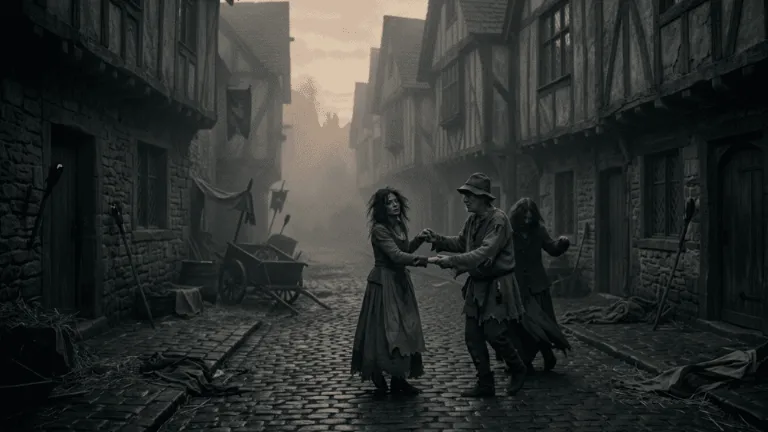
Fear, in other words, became contagious.
Is Mass Psychogenic Illness Still a Real Phenomenon?
The short answer is yes — and it may be more common than you think.
Throughout history, similar outbreaks have occurred. In the Middle Ages, multiple “dancing manias” were recorded across Europe. In the 20th century, factory workers in various countries experienced sudden, unexplained fainting episodes or mysterious illnesses — all later classified as MPI.
More recently, researchers have studied similar patterns in schools, communities, and even online environments, where anxiety and stress-driven behaviors can spread rapidly through social networks.
However, the 1518 outbreak remains uniquely terrifying in scale and duration. Four hundred people, weeks of suffering, multiple deaths — all from stress made physical. It stands as a sobering reminder of what collective human anxiety is truly capable of.
What the Dancing Plague of 1518 Tells Us About Human Nature
Five centuries later, historians and psychologists are still asking the same question: Can collective stress really push human beings this far?
The answer, according to the evidence, is yes.
The Dancing Plague of 1518 is not just a bizarre footnote in history. It is a window into the extraordinary — and terrifying — power of the human mind. It shows us that when people share the same fears, the same hopelessness, the same unbearable weight of survival, the body becomes a vessel for what the mind can no longer contain.
It also reminds us that the line between the psychological and the physical is far thinner than we like to believe. Pain doesn’t always need an injury. Illness doesn’t always need a germ. Sometimes, the mind creates its own crisis — and drags the body along with it.
Conclusion: A Warning Etched in History
The Dancing Plague of 1518 is one of history’s most haunting mysteries — but it is also one of its most important lessons.
It tells us that mental suffering, left unaddressed and surrounded by silence and fear, does not simply disappear. It transforms. It spreads. It takes on a life of its own. And in the worst cases, it can become just as deadly as any physical disease.
Strasbourg’s streets ran not with blood, but with exhausted, tormented bodies that simply could not rest. Behind every dancer was a human being crushed by a world that had become too heavy to bear.
We may live in different times. However, the warning is timeless: never underestimate what collective suffering can do to the human mind — and body.