


No Fridge, No Electricity: The Mughal Empire’s Ice System
The Mughal Empire maintained a sophisticated cold-chain network to supply ice during intense summers. Laborers harvested mountain ice, transporting it hundreds of miles via horse relays and insulated boats. Locally, engineers utilized thermal radiation cooling in winter pits. These supplies were preserved in thick-walled underground vaults called yakhchāls.
A dedicated royal department led by officials known as aabdars managed these resources. Beyond cooling drinking water and flavoring sherbets or frozen desserts like kulfi, ice served as a status symbol. Emperors granted ice as a mark of favor, demonstrating their logistical mastery and control over the environment.
Imagine sitting in a palace during a scorching July afternoon in 16th-century India. The air outside shimmers with heat. Yet, somehow, a servant brings you a chilled rose sherbet, its glass frosted and cold to the touch.
No electricity, refrigerator, or ice machine.
So how did it happen?
The Mughal emperors didn’t just survive summer — they thrived in it. Behind their iced drinks and frozen desserts was a remarkable system of logistics, engineering, and natural science. And it worked beautifully, centuries before modern cooling technology existed.
The Challenge: Keeping Ice in a Land of Blazing Summers
Northern India in summer is relentless. Temperatures in Delhi and Agra regularly soared above 45°C during the Mughal period. Yet historical records from the courts of Humayun, Akbar, and Shah Jahan all confirm the same thing — ice was a regular feature of royal life.
That didn’t happen by accident. It took careful planning, massive manpower, and an impressive understanding of how cold works.
Where Did the Ice Come From? The Mountain Supply Chain
The Mughals sourced their ice from the snow-covered peaks of Kashmir, Himachal Pradesh, and the Garhwal region. Every year, before summer arrived, a large-scale operation swung into action.
Thousands of workers traveled into the mountains and cut enormous blocks of ice directly from glaciers and snowfields. However, cutting the ice was only half the problem. The real challenge was getting it to cities like Delhi, Agra, and Lahore — hundreds of miles away — before it melted.
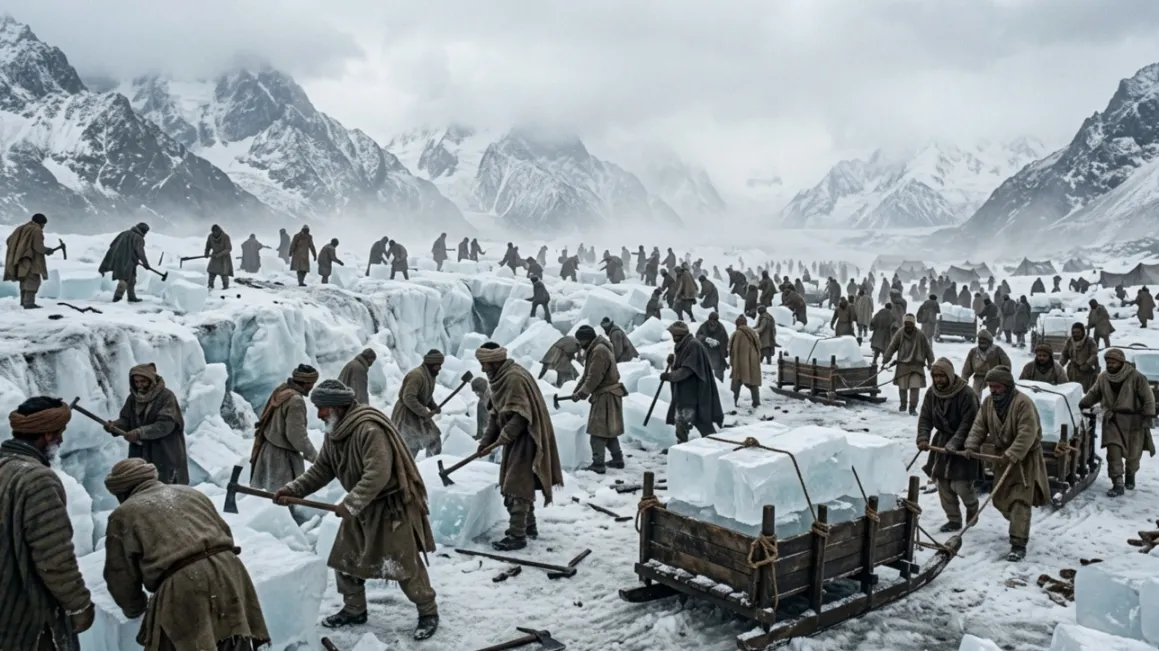
To solve this, the Mughals built one of history’s most impressive cold-chain logistics networks.
Racing the Sun: How Ice Traveled Hundreds of Miles
Speed was everything. Teams of couriers on horseback relayed the ice in stages, passing each load from rider to rider like a relay race. Meanwhile, river routes used boats to speed up delivery along key stretches.
The ice traveled mostly at night to avoid daytime heat. Workers wrapped the blocks tightly in thick cloth, straw, and ash — natural insulating layers that dramatically slowed melting.

Eventually, the ice arrived at its destination. But then another challenge began: keeping it frozen for months.

The Ice Houses: Underground Vaults Built for Cold
When ice reached the royal cities, workers transferred it into specially built structures called yakhchāls or barf khanas — ice houses.
These weren’t ordinary storage rooms. Engineers buried them several feet underground, where the earth itself acted as insulation. The walls were extraordinarily thick, blocking out heat from the scorching surface above.
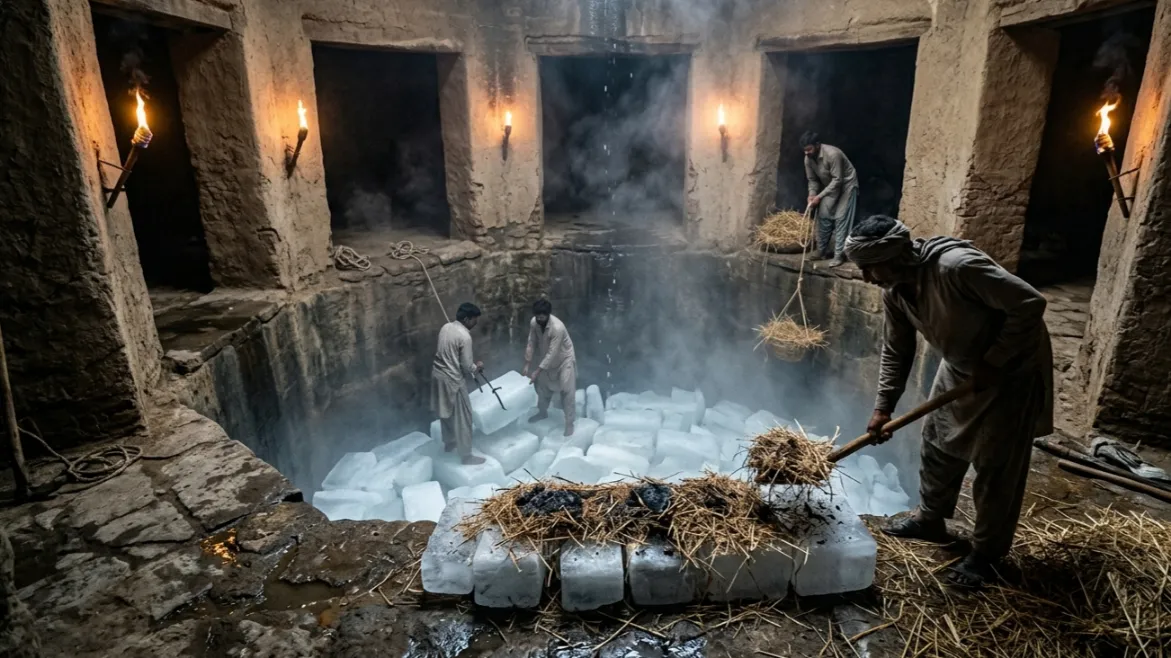
Inside, workers packed the ice in layers of straw, cloth, and ash. This simple but brilliant technique kept ice frozen well into May and June — the hottest months of the Indian summer.
Underground Architecture That Outsmarted the Heat
The design of these ice houses reflected a deep, practical understanding of heat transfer. Thick mud walls resisted thermal conduction. Underground placement used the earth’s stable temperature as a natural buffer.
In addition, the structures were often built to face away from direct sunlight, and some featured ventilation systems that encouraged the circulation of cool air. The result was a remarkably effective cooling environment — built entirely without modern materials or electricity.
The Aabdars: A Royal Department Dedicated to Ice
Perhaps the most fascinating detail of this entire system is that the Mughal court maintained a dedicated department just for managing ice and cold water.
The officials who ran this department were called aabdars — a title that translates roughly to “water keeper” or “keeper of water’s purity.”
However, their responsibilities went far beyond simply handling ice. The aabdars kept the emperor’s drinking water cold around the clock. They supplied the royal kitchen with ice on demand. They managed the preparation and serving of chilled dishes at grand banquets. And they coordinated ice deliveries to members of the royal household.
A Post of Trust and Prestige
The position of Aabdar wasn’t just a practical job — it carried real social standing. Because the aabdar had direct access to the emperor’s food and drink, he had to be completely trustworthy. Poisoning through water or food was a genuine threat in Mughal court politics.
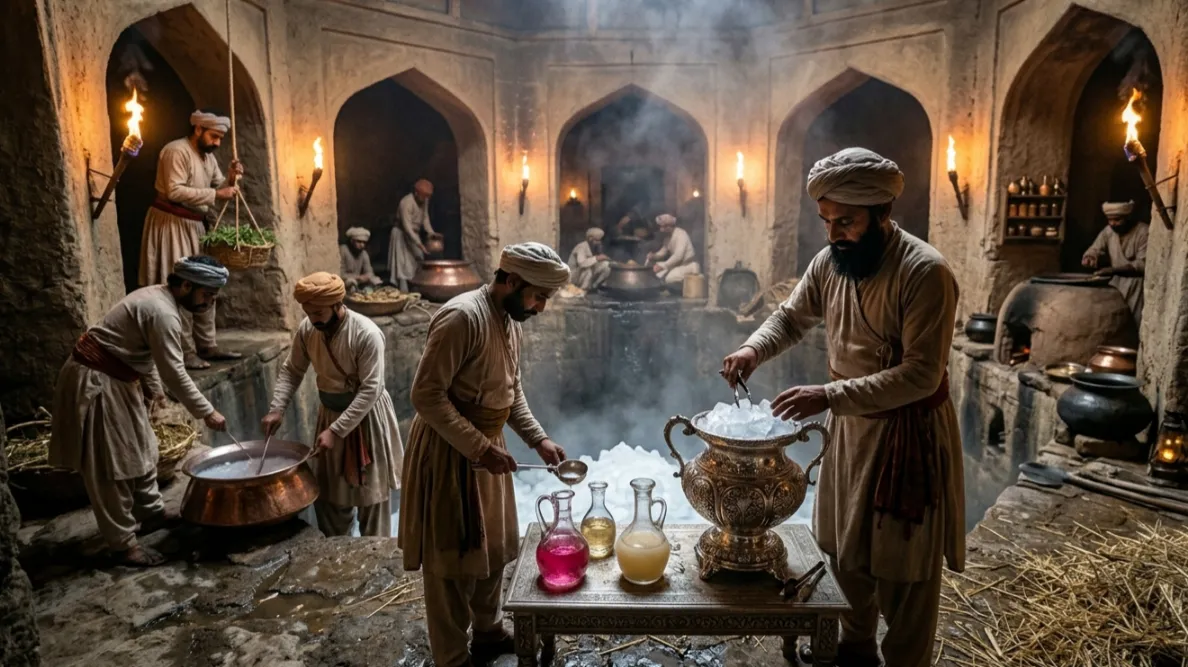
As a result, the emperor selected abdars with great care. Holding the position was considered a mark of personal honor and royal confidence.

Local Ice-Making: The Brilliant Trick of Thermal Radiation
Here’s where the story gets genuinely surprising. The Mughals didn’t rely entirely on mountain ice. In northern India’s flat plains, they actually manufactured ice locally — using nothing but cold winter nights and open sky.
Workers dug shallow pits across open fields and filled them with small, flat earthen pots of water. They left these pots outdoors overnight, exposed to the clear night sky.
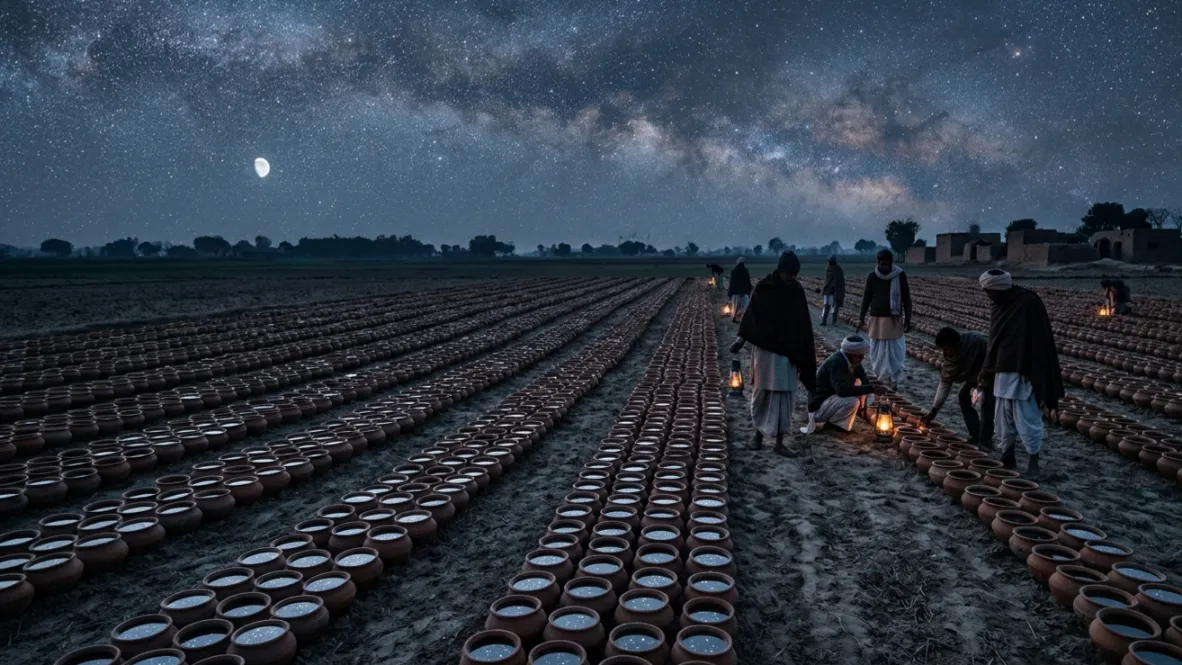
On cold, dry winter nights, the water radiated its heat upward into the atmosphere through a process we now call thermal radiation cooling. Without clouds or humidity to reflect that heat, the water lost enough warmth to freeze into a thin layer of ice by morning.
Ancient Physics, Practical Results
Before the first rays of sunrise could melt it, teams of abdars rushed across the fields collecting the ice. They carried it quickly to underground ice houses, where it joined the mountain supply.

For example, this technique worked especially well during the dry winter months when the air was clear and cold. Meanwhile, the mountain supply served as a longer-term reserve for the hottest summer months.
The Mughals understood the physical principles behind this process — not in the language of modern science, but through careful observation and practical experiment.
What Was Ice Actually Used For?
Ice in the Mughal court wasn’t just for cooling water. It was the foundation of an entire royal food and drink culture.
Chilled sherbets — flavored with rose, sandalwood, and kewra — were a daily luxury. The imperial kitchen churned out kulfi, an early frozen dessert made from thickened milk and spices, which required steady access to ice. Chilled fruit juices and aromatic drinks made from seasonal flowers were also common.
In addition, during major court celebrations and banquets, elaborate frozen and chilled dishes appeared as a display of imperial wealth and taste.
Rooh Afza History: The 117-Year-Old Drink That Survived Partition and Never Changed Its Formula
Ice as a Symbol of Power
Beyond its practical uses, ice carried deep symbolic weight in Mughal society.
Distributing ice to royal ministers and nobles was a recognized act of royal generosity. During the most brutal summer heatwaves, a gift of mountain ice from the emperor was considered a significant honor — a visible sign of imperial favor.

For the Mughal aristocracy, ice wasn’t simply frozen water. It was a statement. It said: ” We have the power, the reach, and the organization to command nature itself.
Conclusion: Genius Without Gadgets
The Mughal ice system stands as one of history’s quiet engineering masterpieces. Without electricity, without refrigeration, and without any modern technology, an entire empire kept its cool — literally.
They built underground vaults, ran mountain courier networks, exploited the physics of thermal radiation, and created a dedicated royal department — all to ensure that Mughal emperors could enjoy ice in summer, no matter how fierce the heat.
It’s a reminder that human ingenuity doesn’t need electricity to be brilliant. Sometimes, all it takes is observation, organization, and the will to solve a problem.