
How a Glassmaker’s Mistake Gave the World Eyeglasses
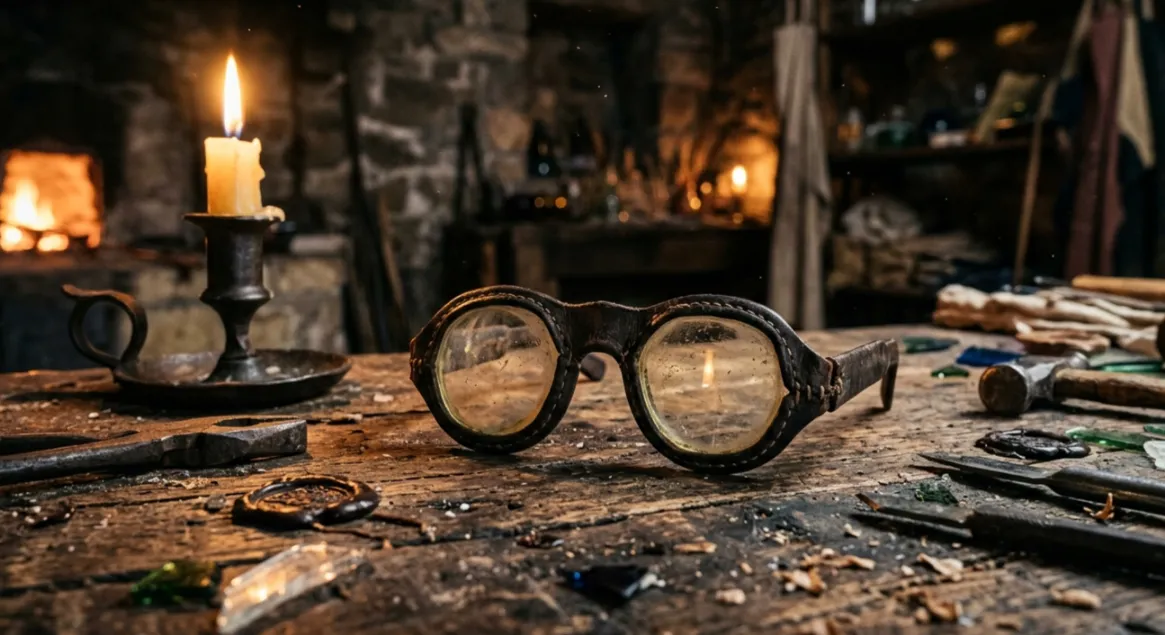
In thirteenth-century Italy, glassmaker Salvino D’Armate discovered that curved glass lenses could correct age-related vision loss. By mounting these lenses into a leather frame, he created the first eyeglasses. This invention provided a solution for scholars and craftsmen whose careers previously ended when their eyesight began to fail.
The introduction of spectacles significantly extended the productive lives of literate and skilled workers across Europe. This advancement supported the growth of intellectual culture and literacy during the Renaissance. D’Armate’s observation of light refraction eventually laid the foundation for modern optical sciences, including the development of telescopes and microscopes.
Imagine losing your ability to read, sew, or do any detailed work — not because of illness or injury, but simply because you turned forty.
For most of human history, this was reality. Blurry vision after middle age was considered an irreversible curse of growing old. No remedy existed. No hope was offered. People simply accepted it and faded into helplessness.
Then, in thirteenth-century Italy, a young glassmaker peered through a curved piece of glass — and everything changed.
A World Going Blurry
In the medieval world, failing eyesight was one of the most feared consequences of aging.
Once a person crossed the age of forty, their vision typically began to deteriorate. For most people, this meant the end of any work that required close focus. Scholars could no longer read their manuscripts. Seamstresses could no longer thread a needle. Craftsmen could no longer perform the delicate tasks that defined their livelihoods.

There was no fix. No workaround. Society simply accepted that aging meant losing the ability to see clearly — and with it, the ability to fully participate in life.
The Young Glassmaker of Pisa
Around 1280, in the workshops of northern Italy, a young artisan named Salvino D’Armate was doing what he did every day — melting, shaping, and polishing glass into various forms.
He was skilled at his craft. But something weighed on him beyond the work itself.
His elderly father’s eyesight had been failing for years. Salvino had watched the man he admired struggle to read, squinting at text that had once been effortless. It was a quiet, constant frustration — one that no physician of the age could resolve.

Salvino kept working. And one afternoon, without planning it, he stumbled onto something that would outlast everything else he ever made.

The Moment Everything Became Clear
While polishing a thick, curved piece of glass, Salvino’s attention drifted. He glanced through the lens at some small tools lying on the workbench below.
He stopped.
The tools — which normally appeared blurred at that distance — looked completely sharp through the glass. Larger, clearer, almost magnified. He blinked and looked again.
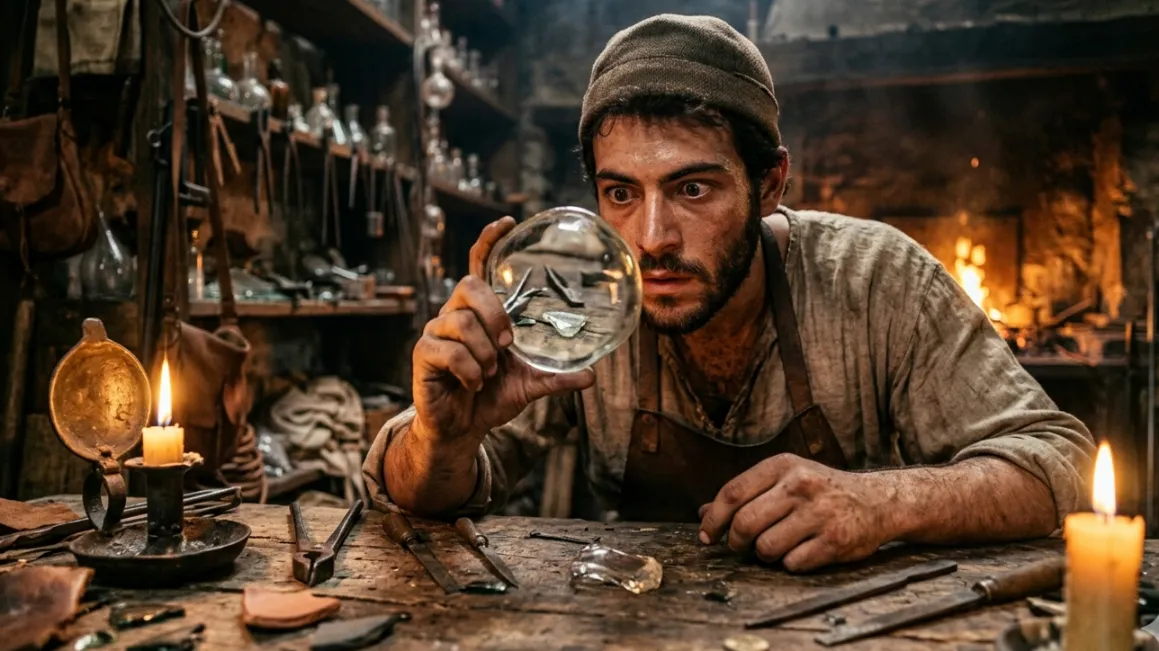
The curved glass was bending light in a way that corrected what the human eye could not do on its own.
Salvino immediately grasped what he was seeing. This was not just an interesting quirk of light. This was a solution.
Building the World’s First Eyeglasses
Moving quickly, Salvino ground and shaped two curved glass lenses to match what he had observed. He then fitted them into a simple leather frame — one lens for each eye — designed to rest on the bridge of the nose.
It was a rough, rudimentary device by modern standards. But it worked.
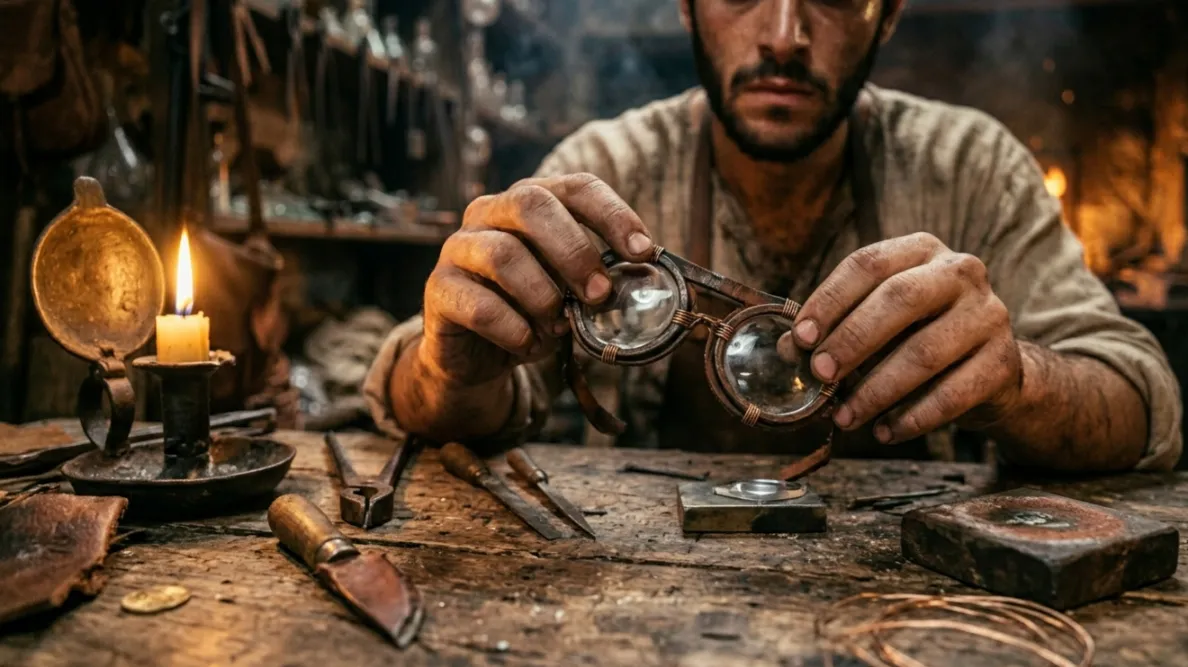
He brought the finished spectacles to his father and placed them on his face.
For a moment, nothing was said.
Then his father picked up a piece of text he had not been able to read in years — and read it.

A world that had gone blurry came back into focus. Not gradually. Not partially. Clearly.

The Invention That Changed the Course of History
The invention of eyeglasses may not carry the drama of a battlefield victory or the grandeur of a cathedral. But its impact on human civilization is difficult to overstate.
Before spectacles, a scholar’s productive life effectively ended at middle age. After Salvino’s discovery, it didn’t have to.
Within decades, eyeglasses spread across Italy and into the rest of Europe. Craftsmen, monks, scribes, and scholars who had resigned themselves to blurred vision could suddenly work again — sometimes for decades longer than they could have otherwise.

In addition, the spread of literacy, the survival of manuscripts, and the broader intellectual culture of the Renaissance all owe something to that simple leather frame with two curved lenses.
Eventually, the technology evolved. Frames became more refined. Lenses were ground with greater precision. Centuries later, the same fundamental principle behind Salvino’s discovery would lead to microscopes, telescopes, cameras, and the optical sciences that define modern medicine and technology.
The Volcano That Forced Humans Off Horses and Onto Wheels
A Discovery Born of Observation
What makes Salvino D’Armate’s story remarkable is not just what he invented — it is how he invented it.
He was not a university-trained philosopher or a wealthy patron funding experiments. He was a craftsman who paid close attention to what was in front of him.
A moment of distracted observation. A piece of curved glass. A set of blurry tools that suddenly came into focus.
That was all it took.

History does not always belong to the formally educated or the well-resourced. Sometimes it belongs to the person who simply stops and looks.
Conclusion
The invention of eyeglasses is one of history’s quieter revolutions — easy to overlook precisely because it became so ordinary. Today, billions of people wear spectacles without a second thought.
But behind that unremarkable pair of glasses on your face or on your desk is a story from thirteenth-century Italy. A young glassmaker. A worried son. A curved piece of glass that caught the light just right.
Salvino D’Armate did not set out to change the world that afternoon. He was just doing his job — and paying attention.
Sometimes, that is enough.